| Trekking
Rudranath: Face of Shiva |
|||||
From Chopta the road snakes down steep mountain slopes covered by dense forests and it seems that the forest has reluctantly granted the road right of passage. There are very few settlements along this road. Only the occasional vehicle travelling between Kedar & Badri seeks out this alternate, less frequented and very picturesque road. We reached Mandal, 24kms away, within a couple of hours. AT Mandal we stayed at Bhagat Bisht's Hotel, directly opposite the archway proclaiming "Anusuya Mata Mandir Marg". We arranged for three porters, certified to be reliable by Bhagat, purchased provisions for three days for 7 people, and ate a sumptuous dinner. At sundown we met an elderly gentleman at the end of his reserves, hurling the choicest abuses at Lord Shiva whose darshan he had sought at Rudranath. He complained that he had been drenched twice in huge downpours, fallen repeatedly on the slippery forest paths and invited death by stepping on a huge Cobra! This fresh narration compounded our fears as another traveller on this path, whom we had met at Ukhimath, mentioned that he had seen a partially eaten carcass of a deer near a glacier at Nayla pass. A local told us that a villager had been ripped open by a bear a few days back on the road to Anusuya Mata Mandir. We were keenly aware that this was an arduous trek through dense forests devoid of any human settlements and with no watering holes. Our sense of foreboding and apprehensions were at an all-time high! |
More on Uttarakhand • Overview • Char Dham
Trekking
Photo Gallery
Travelogues
Adventure activities | ||||
We reached the temple of Anusuya Mata at 1030 am. At the foot of a rather formidable mountain, this temple is situated in the midst of a dense forest that stretches as far as the eye can see. The houses here are built on top of a cowshed protecting precious livestock. There is a lovely temple situated at the far end of this village named after this temple. We stayed at the Mandir committee guest house within the premises, where we were provided with 2 blankets each as bedding! We were quite amused but on retrospect it was a luxury. From Anusuya there is a beautiful path leading up into the forest. After a couple of kms there is a bifurcation with the onepath on the right leading to the unique meditation cave of Atri Muni which has a waterfall as its curtain! (Reminds one of Phantom!). We offered Pujas at this temple held in great esteem by locals. A childless couple from Mumbai had come with a large retinue to perform an elaborate Yagna which requires 11 priests to chant Vedic Mantras for 7 days! I first heard an interesting legend associated with this temple from a priest at the Datttreya mandir at Mount Abu in Rajasthan. The story goes that at Narada's instigation, Bramha, Vishnu & Shiva were asked by their wives to verify if Anusuya Devi, wife of Atri Muni, was truly the most pious woman of all. The convoluted story aside, it is believed that all three wives, goddesses in their own right, eventually came to seek her darshan.
At places the path was blocked by the trunks of huge trees fallen at nature's behest - a rare sight. The path was uniformly reddish brown with a goldmine of compost that could fertilize hectares of farmland. After about 4 hours of trekking we came to a grassy knoll overlooking the Anusuya Mata village & we marvelled at having climbed so high so soon. The narrow path in the thick mountain grass was very slippery and often we had to grab at handfuls of grass to arrest our fall. At the Hamsa-Bugiyal/meadow, there was a shepherd's hut on stilts, bathed in bright sunlight. Gradually the forest thinned and the evergreens gave way to conifers, less tall trees & ultimately to gnarled trees. We reached a small patch of flatland with a few sun-baked flat rocks, called Dhanpal maidan. This was the last point where there was any possibility of obtaining drinking water. We stretched out gratefully on the inviting rocks. After breakfast we drank water to our hearts' fill before refilling our bottles and adding the mandatory Zeoline to purify the water.
The steep and frequently narrow route was through undulating grasslands along a broken mountain path. As our respiration grew laboured, we were aware of gaining altitude. Dark clouds were gathered in the afternoon. Often we were enveloped in rising clouds. At about 4 pm we reached Nayla pass at a height of 14,000 feet. Here with the poor visibility it is easy to get lost without a guide. During our return journey we had a wonderful view of this grassy pass. We crossed the mountain and started on our way down to the temple of Rudranath, at a height of about 11,500 feet.
Initially the path was gentle and inviting. As it started raining, the ground became increasingly more slippery, with poor visibility, reduced further with my rain-drenched spectacles. Thankfully the rain was short-lived and not accompanied by the strong winds that are usual at passes. Soon I came to the first of several glaciers. It was 50 feet across and my companions were way ahead. The failing light made it even more foreboding. I paused. I was very relieved to find Red Riding Hood approaching from another path, through the mist. It turned out to be Romola in a red parka! She taught me my first lesson on how to negotiate glaciers, before preceding me on her way across. I handled the next five smaller glaciers quite well. This path was through extensive acres of thick rhododendron bushes in full bloom. The entire mountainside was violet. I had never seen anything so colourful before.
Romola Butalia's account of Sagar-Rudranath-Mandal trek On this rocky mountainside are a few huts that house any pilgrim who comes here. They are very basic wooden structures with corrugated iron sheet roofing, some with floor of packed earth strewn over by dried grass(Phus) and others with wooden boards for flooring . These huts have a door and a couple of barred windows that act as ventilators with a sunken fireplace guarded by a few stones. The walls are covered with soot and it is very dark inside. The path leads to a small hut etched into the mountain. This is the famous temple of Rudranath.
There is a natural ledge overhanging this face from where droplets of water fall perennially. The temple is very damp and cold with small puddles here and there. There are a few pieces of flat wood on which the pujari or temple priest and his assistant stand during the performance of the elaborate rituals. The large half open eyes of the deity are kept covered with larger golden coverings. The enormous upturned, golden moustaches transform this face into a terrifying angry face. Every evening, in elaborate worship, the mask is removed from the face of Shiva to give a brief glimpse of a rarely-sighted aspect of Shiva. This is the only temple of Shiva where his face is his symbol.
There is a small ledge in front of this temple where there are a few stone face-shaped statues akin to the Zulu masks seen on the shields of African warriors. These are regarded as the Vandevatas. In a cave beyond Rudranathji are a few enormous and menacing weapons including swords and maces, as well as precious ornaments. These are believed to belong to the Pandavas hence this cave is also called Pandava Cholas.
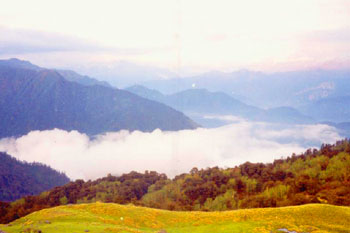
Across the drop in front of this ledge is an expansive grassland with a quaint shepherd's hut and a flock of sheep that appeared as ants from this height. Beyond this short stretch the forests begin, only to get lost in waves upon waves of mountains. The sunrise on a clear day reveals beautiful ice capped mountains in the horizon. This temple closes before any of the other Panch Kedars, and during the long winter months Pujas are offered to the Deity from Gopinath temple at Gopeshwar. Having spent two nights at Rudranath, we tramped back the entire distance to Mandal on the next leg of our journey to Tungnath on the Panch Kedar Yatra.
|
|||||
 |
|||||
Editor: Romola Butalia (c) India Travelogue. All rights reserved. |
|||||
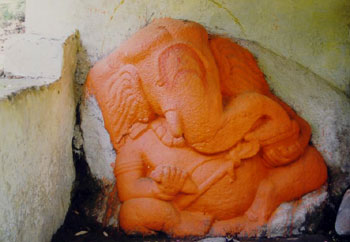 The next morning we started late having already decided to stay at Anusuya Mata, an easy and serene 5 km trek uphill from Mandal, a relatively large settlement by Himalayan standards. We walked along a swift stream called Balkhillya Nadi along a winding path through forests and terraced fields of paddy. Several irrigation channel sluices suggested good cultivation, which was borne out by the double-storeyed houses, some of which had dish antennae. At the end of a rather steep climb, we came across a beautiful 6 feet tall Ganesha carved out of a single piece of rock, housed in a sunken platform in a tin shed. There was a tap offering piped drinking water nearby. We took a brief halt, washed our hands and prayed fervently at Bighna Nashak, Vinayak's saffron statue.
 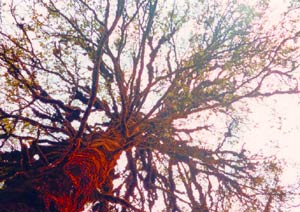 We had puri-sabji cooked and packed amidst heavy rain, venturing out in a gentle drizzle at about 5 am. It was dawn when we reached the bifurcation of the path to Atri Muni's gufa. We could now see nature's bounty as tall evergreen trees welcomed us into an unknown realm. The rain stopped and we heaved a sigh of relief. The path was easy enough at the outset with a dense carpet of fallen leaves masking our footsteps and reminding us to walk in silence. There were occasional thickets of bamboo but there was almost no grass. The dense foliage filtered almost all light and it felt like we were walking in a semi-lit tunnel. The silence was eerie, broken only by the occasional chirping of crickets.
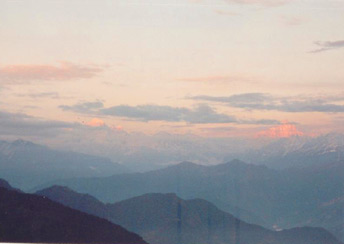 Soon enough I reached Narada Kund - a natural spring of fresh water with a small temple and an archway with bells which proclaimed my approach to this sacred place in a remote niche of the Himalayas. From Narada Kund the steep mountain path leads to a landing which is about 10 feet across with a steep fall of about 250 feet on one side and a near vertical mountainside on the other.
 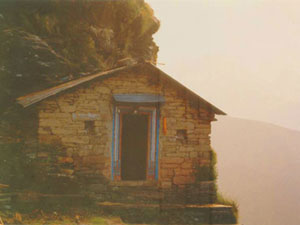 According to the legends of Panch Kedar, this temple shelters the face of Shiva. There is a small rectangular space just outside the sanctum sanctorom. The deity is a Swyam Bhuva (Self Appeared) Shivalinga shaped like a human face formed by the projection of a huge rock. This face has a serene smile and a gaze of pure benevolence in the all-seeing eyes. I had not expected anything so wonderful. Measuring about 3 feet from the chin to the top of the jatas, a white cloth remains bound tightly on the crown of Lord Shiva, which I did not see removed during the day and a half spent here.
 From the accounts of Umaprasad Mukherjee, I was aware of a 5 feet by 5 feet statue of Vishnu situated in a small temple about 1 km away, beside a natural spring known as Vaitrani Kunda. According to him this is an exquisitely carved statue with the deity reclininng on Shesha Nag. It has now been brought to the main temple. The priest showed me the beauty of this statue by the light of a solar lantern held up. It has a lotus springing from Narayana's navel with a deity on the lotus, believed to be Brahma. The details are breathtaking. It is carved out of a single piece of stone!
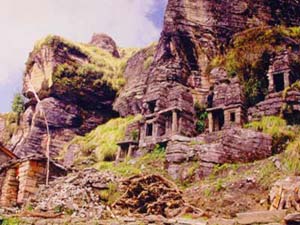 Wild beasts regularly visit this temple though they are not known to have harmed any pilgrim. On the mountainside above this temple are a few smaller rock temples, a reminder of Ajanta-Ellora. These are all Shiva temples.