| Destinations
|
|||||||||
Wildlife of Kashmir No animal better exemplifies the character and concerns of
mountain environment than the snow leopard, a beautiful and
elusive survivor from the frigid Pleistocene era. Though its
presence extends over the entire Himalayan range, it is most
advantageously sought in the higher reaches of Jammu and
Kashmir. Another rare animal is the hangul or Kashmir stag,
one of the most endangered species of red deer in the world.
Cinnamon sparrows, black and yellow grosbeak, black bulbuls,
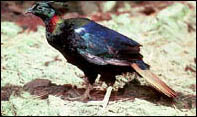
the psychedelic male monal pheasants and the impressive
Himalayan grey langur can be spotted in the lower valleys
during winter. Come spring and summer, the long foothills and
deep valleys awaken to the imposing Himalayan black bear and
the lovely golden oriole. The dense forests of Kashmir are
home to ibex, snow leopard, musk deer, wolf, markhor, red
bear, black bear and the leopard. Among the commonly seen
birds are ducks, geese, partridge, chakor, pheasant, wagtails,
herons, water pigeons, warblers, and doves.
In the hilly regions of Doda, Udhampur, Poonch and Rajouri
there is large and varied fauna including leopard, cheetah and
deer, wild sheep, bear, brown musk shrew and musk rat.
Varieties of snakes, bats, lizards and frogs are also found in
the region as are birds like chakor, snow partridge, pheasants
and peacock.
|
More on Kashmir • Overview • History • Geography • People • Economy • Festivals • Adventure • Tourist Information • Climate Cities: • Dachigam • Drass • Gulmarg • Jammu • Pahalgam • Sonamarg • Srinagar • Ladakh
Travelogues
Adventure activities | ||||||||
 Jammu and Kashmir valley have been active in wildlife conservation efforts. Several National Parks and sanctuaries have been established in the state including those at Dachigam, Overa and Gulmarg. Overa- Aru Biosphere Reserve Accommodation How to get There Best Season Whom to Contact: Gulmarg Biosphere Reserve Multiple species of rare and endangered fauna like hangul, musk deer, brown bear, leopard and black bear are provided protection in the Biosphere Reserve. The area has a good population of pheasants and upland birds, both resident and migratory. The common birds are griffon vulture, monal, snow cock, koklas, blue rock pigeon, Kashmir roller, European hoopoe and jungle crow. Accommodation How to get There Best Season Whom to contact Wullar Lake
Dal Lake
The man made islands within the lake comprise of reeds, willow rods and aquatic vegetation, which provides a rich source of food in the form of frogs, lizards, mice, grasshoppers and other insects to the kingfisher. Bees hum around open lotus flowers collecting honey. Wagtails, active and eager, can be seen dashing from leaf to leaf, sometimes leaping into the air to catch its prey. The dipping motion of their long tails and their undulating flight is fascinating to watch. The little grebe, a small swimming bird much smaller than a duck, is fairly common in the vale. Common pariah kites (Milvus Migrans) are scavenger birds and help clean the area. Compiled by Puneet Sachdeva |
|||||||||
 |
|||||||||
Editor: Romola Butalia (c) India Travelogue. All rights reserved. |
|||||||||
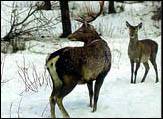 The largest mountain range in the world, the Himalayas, is one
of the richest havens for animal life. The eco-system here is
well balanced with animals and people coexisting peacefully.
It is remarkable that almost one third of the world's
mammalian species that may be called true mountain animals are
native to these mountains. The topography of Jammu and Kashmir
offers a wide variety of climate and vegetation making the
state a wildlife enthusiast's delight.
The largest mountain range in the world, the Himalayas, is one
of the richest havens for animal life. The eco-system here is
well balanced with animals and people coexisting peacefully.
It is remarkable that almost one third of the world's
mammalian species that may be called true mountain animals are
native to these mountains. The topography of Jammu and Kashmir
offers a wide variety of climate and vegetation making the
state a wildlife enthusiast's delight.
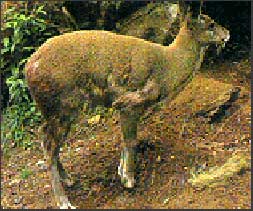 The Sanctuary is situated about 76 km from Srinagar in the
south-east and located near Pahalgam. It is famous for
retaining several rare and endangered species like the hangul,
musk deer, brown bear, leopard, koklas, monal and snow cock.
It sustains 13 species of mammals and over 80 species of
birds. It is eminent for its varied and magnificent species of
pheasants. This area, as distinct from the other wildlife
reserves of the valley, is rich in pheasants like the chukar,
koklas, monal and Himalayan snow cock. Other avifauna include
the jungle crow, red billed chough, griffon vulture, bearded
vulture, Himalayan whistling thrush, rufous-backed shrike and
Indian mynah, among others.
The Sanctuary is situated about 76 km from Srinagar in the
south-east and located near Pahalgam. It is famous for
retaining several rare and endangered species like the hangul,
musk deer, brown bear, leopard, koklas, monal and snow cock.
It sustains 13 species of mammals and over 80 species of
birds. It is eminent for its varied and magnificent species of
pheasants. This area, as distinct from the other wildlife
reserves of the valley, is rich in pheasants like the chukar,
koklas, monal and Himalayan snow cock. Other avifauna include
the jungle crow, red billed chough, griffon vulture, bearded
vulture, Himalayan whistling thrush, rufous-backed shrike and
Indian mynah, among others.
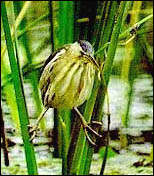 Spread over 180 sq. km 2400 to 4300 m above sea level, the
Biosphere Reserve is famous for retaining several rare and
endangered species of flora and fauna. The area has a rich
foliage cover. The main species of conifers, which account for
over 90% of forests, are Cedrus deodara, Pinus griffithii,
Abies pindrow and Aesculus indica. Major shrubs in the reserve
are Indigofera heterantha, Viburnum spp., Sorbaria tomentosa
Dicotyledonus.
Spread over 180 sq. km 2400 to 4300 m above sea level, the
Biosphere Reserve is famous for retaining several rare and
endangered species of flora and fauna. The area has a rich
foliage cover. The main species of conifers, which account for
over 90% of forests, are Cedrus deodara, Pinus griffithii,
Abies pindrow and Aesculus indica. Major shrubs in the reserve
are Indigofera heterantha, Viburnum spp., Sorbaria tomentosa
Dicotyledonus.
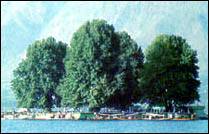 This fresh-water lake, 60 km from Srinagar, spreads over a 125
km area. Wullar lake draws excess water from the Jhelum and
acts as a natural flood reservoir. Interesting ruins in the
centre of the lake are the remains of an island created by
King Zain-ul-abidin. With its turbulent, perpetually
wind-ruffled waters, it's exciting variety of avian life
enhances the sheer beauty of its setting.
This fresh-water lake, 60 km from Srinagar, spreads over a 125
km area. Wullar lake draws excess water from the Jhelum and
acts as a natural flood reservoir. Interesting ruins in the
centre of the lake are the remains of an island created by
King Zain-ul-abidin. With its turbulent, perpetually
wind-ruffled waters, it's exciting variety of avian life
enhances the sheer beauty of its setting.
 Kingfishers sit on the tops of houseboats within touching
distance of humans. In Europe, these birds are very elusive,
but in the Kashmir valley they do not fear humans. Man and
nature seem to co-exist happily together in the valley. The
white-breasted kingfishers (Halycon smyrnensis) with robust
bills are perched on the branches of willow trees and dive
directly into water to catch little fish.
Kingfishers sit on the tops of houseboats within touching
distance of humans. In Europe, these birds are very elusive,
but in the Kashmir valley they do not fear humans. Man and
nature seem to co-exist happily together in the valley. The
white-breasted kingfishers (Halycon smyrnensis) with robust
bills are perched on the branches of willow trees and dive
directly into water to catch little fish.