| Destinations
|
|||||||||||||||
Overview Ladakh forms part of the state of Jammu and Kashmir in India. Some
areas of Ladakh are under the illegal occupation of Pakistan and
China. The borders of Ladakh touch those of Afghanistan, Pakistan,
China, the Kashmir Valley and Himachal Pradesh. Made up of two
administrative districts - Leh and Kargil, Ladakh covers a total
area of about 59,000 square kilometers.
Before the use of aircrafts, Ladakh could only be reached by road.
The main land approach to Ladakh is the 434 km Srinagar-Leh highway,
with Kargil en route. For the most part, this road follows the
historic trade route, thus giving travellers a glimpse of villages
that are historically and culturally important. The most dramatic
part of the road journey to Kargil is the ascent up the Zoji La pass
(14,000 ft) in the Great Himalayan Range that serves as the gateway
to Ladakh. More recently, the Manali-Leh road, crossing several high
passes including Tanglang La (18,200 ft), has started serving as a
second artery of commuting between Ladakh and the rest of India. To
the north lie the Saser La and Karakoram passes, gateways to Central
Asia from where trading caravans used to come for many centuries.
|
More on Ladakh • Introduction • Zanskar • Drass • Kargil • Suru Valley • Mountaineering • Ladakhis Places to Visit • Drass • Gulmarg • Jammu • Pahalgam • Sonamarg • Srinagar • More on Ladakh • Travelogues • Kashmir • Journey to Ladakh
Adventure |
||||||||||||||
History
Thus, while the Mons are believed to have carried north-Indian Buddhism to these highland valleys, the Darads and Baltis of the lower Indus Valley are credited with the introduction of farming and the Tibetans with the tradition of herding. The settlements that evolved as a result of intermixing of these elements-ethnic, occupational and cultural-now serve at home to a syncretic micro-society of J&K state. 
Villages in Ladakh Crowning the chief hill of the village and dominating its life, as its position would suggest, is the monastery. The road both enters and leaves the village through a "chorten" gate. Apricot trees against a background of azure sky and glittering peaks surround these fascinating villages. The houses are clustered above the area of cultivated terraces at the foothills. Approached by stony paths or tracks, the houses are so built into the hillside that convenient pieces of rocks often serve as walls or floors. Often rock overhangs are used as roofs and a sunny platform will be enclosed with rough walls to stable animals by day in winter. In the bigger houses, one room is dedicated as a little private chapel, used mainly by the master of the house for reading his holy books and saying his prayers. Where a whole room cannot be set aside, a small corner in the best room will be arranged as an altar. The Dras Valley The river Shigar flowing from the north, drains an adjoining part of the Dras Valley. In summer, as the snow in the uplands melts, the volume of this river rises considerably. It meets the Suru River near Kharul a short distance away from Kargil. The terrain is characterised by rock and stone with the occasional greenish patch formed by willow and groves. The short summers of Dras begin in May, when the snow begins to melt. Crop sowing activities start late, while harvesting is done early so that the crops are reaped before the beginning of snowfall. Barley and other coarse cereals are the main crops grown here. Agricultural production is hampered due to the poor and unproductive soil and the short growing season. Moreover, there is a lack of irrigation facilities in many parts of the Dras valley. As a result, agricultural yields are not enough to meet the needs of the people living in this valley. Food grains have to be imported from Kashmir. Fuel too is a scarce commodity and has to be brought in from across the Zoji La Pass. The inhabitants of Dras valley, the Brokpas, migrated to this tract from Gilgit several centuries ago. Tourism & Adventure The itinerary of the average tourist to Ladakh begins with a tour of Leh, the ancient capital and principal township of Ladakh. It invariably includes visits to a selection of monasteries located along a stretch of the Central Indus Valley, between the spectacular monastery of Lamayuru in the west and the prestigious establishment of Hemis in the east. Some take to trekking along the lateral valleys, especially in Markha, but few venture out of the confines of the central Indus valley, which represents Ladakh's heartland. Several outfits in India and abroad organize long treks and tours in the region. There are a select few companies specializing in organizing mountaineering expeditions to the Nun-Kun region and the Zanskar Mountains. Compiled by Puneet Sachdeva
|
|||||||||||||||
 |
|||||||||||||||
Editor: Romola Butalia (c) India Travelogue. All rights reserved. |
|||||||||||||||
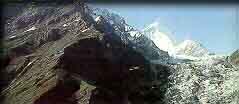 Across the Kashmir Valley and over the famous Zoji La pass lies
Ladakh - the Land of High Passes. It is a magical land, completely
different from the green landscape of many other parts of the
Himalayas. It is nature at an extreme. A land of freezing winds and
burning hot sunlight, Ladakh is a cold desert lying in the rain
shadow of the Great Himalayas and other smaller ranges. Little rain
and snow reaches this dry area, where natural forces have created a
fantastic landscape.
Across the Kashmir Valley and over the famous Zoji La pass lies
Ladakh - the Land of High Passes. It is a magical land, completely
different from the green landscape of many other parts of the
Himalayas. It is nature at an extreme. A land of freezing winds and
burning hot sunlight, Ladakh is a cold desert lying in the rain
shadow of the Great Himalayas and other smaller ranges. Little rain
and snow reaches this dry area, where natural forces have created a
fantastic landscape.
 Climate
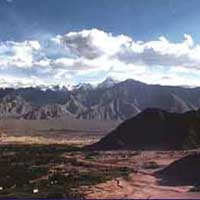 The streams here come from the glaciers of
the higher reaches and form parts of rivers most of which eventually
flow into the Indus. Wherever a stream roams through a broadening
valley, it is possible to lay a series of terraced fields, which can
be irrigated in turn by directing the water supply into small
artificial water courses.
The streams here come from the glaciers of
the higher reaches and form parts of rivers most of which eventually
flow into the Indus. Wherever a stream roams through a broadening
valley, it is possible to lay a series of terraced fields, which can
be irrigated in turn by directing the water supply into small
artificial water courses.
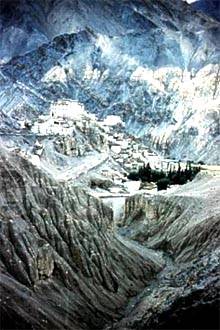 Dras is an enchanting valley formed by the Dras river, which rises
in the Machoi glacier near the famous Zoji La pass. The river is
joined in its course by many other rivers and streams flowing in
from snowfields in the nearby mountains.
Dras is an enchanting valley formed by the Dras river, which rises
in the Machoi glacier near the famous Zoji La pass. The river is
joined in its course by many other rivers and streams flowing in
from snowfields in the nearby mountains.