| Destinations
|
|||
About 20 Kms, south-east of Rangdum stands the Pazila watershed across which lies Zanskar, the most isolated of all the trans-Himalayan valleys. The Penzila Top (4401 m) is a picturesque table land adorned with two small alpine lakes and surrounded by snow covered peaks. As the Zanskar road winds down the steep slopes of the watershed to the head of the Stod Valley, one of Zanskar's main tributory valleys, the majestic "Drang-Drung" glacier looms into full view. A long and winding river of ice and snow, the "Drang-Drung" is perhaps the largest glacier in Ladakh, outside the Siachen formation. It is from the cliff-like snout of this extensive glacier that the Stod or Doda River, the main tributary of River Zanskar, rises.
Zanskar comprises a tri-armed valley system lying between the Great Himalayan Range and the Zanskar mountains; the three arms radiate star-like towards the west, north and south from a wide central expanse where the region's two principal drainages meet to form the main Zanskar River. It is mainly along the course of this valley system that the region's 10,000 strong, mainly Budhist population live. Spread over an estimated geographical area of 5000 sq. kms, Zanskar is surrounded by high-rise mountains and deep gorges.
The area remains inaccessible for nearly 8 months a year due to heavy snowfall resulting in closure of all the access passes, including the Penzi-la. This geographical isolation together with the esoteric nature of Budhism practised here has enabled its inhabitants to preserve and perpetuate their cultural identity. To-day, Zanskar has the distinction of being the least interfered with microcosms of Ladakh, and one of the last few surviving cultural satellites of Tibet. Closer observation of the living conditions evokes admiration for a people who have learnt to live in perfect harmony with the unique environment. |
More on Ladakh • Overview • Introduction • Drass • Kargil • Suru Valley • Mountaineering • Ladakhis Places to Visit: • Drass • Gulmarg • Jammu • Pahalgam • Sonamarg • Srinagar • Ladakh • More on Ladakh • Travelogues • Kashmir • Journey to Ladakh
Adventure |
||
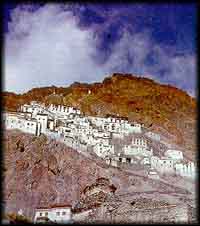 Within the mountain ramparts of this lost Shangrila stand a number of ancient yet active monastic establishments. Some of these religious foundations have evolved around remote meditation caves believed to have been used by a succession of famous Budhist saints for prolonged meditation in pursuit of knowledge and enlightment.
What to see: Padum: Once the capital of the ancient kingdom of Zanskar, Padum (3505 m) is the present-day administrative headquarters of the region. Its old part comprising inter-connected abode houses and several high-rise chortens surround a boulder strewn hillock, site of the erstwhile palace and fort. The new, upcoming township is fast encroaching upon the cultivated expanse downwards, and a small bazar is coming up along the newly built road. With a population of nearly 1500, Padum can be described as the most populous settlement of Zanskar, otherwise a very scarcely inhabited valley. Incidentaly, it is only in Padum that there is a community of Muslims constituting nearly half the township's population, its origin in the area dating from mid 17th century. Lately, Padum has become famous as a major trekking base and a popular tourist destination. Several places of tourist interest in the vicinity of the township can be visited in the course of entertaining walks. The nearest momument is a set of ancient rock carvings on a huge boulder near the river bank, just below the old township. These date from the 8th century and provide epigraphic evidence that the region was under the influence of North Indian Budhism since ancient times. The Stagrimo Monastery with about 30 resident monks clings to a tree-covered ridge above the old town, at an hour's uphill walk, along flower-strewn lush green hill slopes. Across the expanse of cultivation lies the old village of Pibiting, dominated by its picturesque hilltop monastery, a superb manifestation of stupa architecture.
 Sani is also associated with Naropa, the famous Indian Yogi from Vikramsila, who is said to have sat in meditation for some time under the Kanika Stupa. The site is now occupied by a small room housing a veiled bronze figure of the Yogi which is unveiled once a year in late July. A 2 day long festival is held to celebrate this occasion which is attended by people from far and wide while monks from Bardan Monastery perform masked dances as ritual offering. Karsha: The largest monastic establishment of Zanskar, Karsha Gompa is an imposing complex of neatly white-washed adobe blocks comprising several chappels, besides residential rooms for its nearly 150 resident monks. Built picturesquely along the steep gradient of the mountainside above the Stod River, the monastery can be seen from far and wide. The central building is a large assembly hall housing an array of figures and the ornate throne of the Lama-incarnate. This isused for holding elaborate prayer sessions, an occasion worth seeing. Three other adjoining chappels contain numerous statues and other art objects among which a set of exquisite silver and copper chortens are worth noting. A set of old Thangkas adorning the walls of one of the chappels is worth beholding for their artistic beauty. Of particular interest in the complex is the Lhabrang, a large chamber accessible through a vent in the roof, whose partially damaged walls are still adorned with the original frescos which are believed to be nearly 300 years old. The event to witness at Karsha is the 3-day long Gustor Festival held during early July when thousands of devotees throng the monastery to witness the ritual dances performed by mask-wearing monks.
The foot approach to Karsha across a temporary bridge over the Stod River takes about 3 hours from Padum. But it is also connected with the Kargil-Padum road by a 17 km-long link road branching off from the Tungri bridge head, 12 kms short of Padum. Stongdey: Perched on a rocky outcrop overlooking the oasis-like village below, the picturesque monastery of Stongdey lies 18 kms. to the north of Padum, on the road leading to Zangla. An old foundation associated with the Tibetan Yogi, Marpa, Stongdey is now the second largest monastic establishment of Zanskar, inhabited by a resident community of about 60 Gelukpa monks. The sprawling whitewashed complex has a number of temples, each a repository of the region's rich monastic legacy. Of particular interest here is the Gon-Khang, a well guarded room containing several fierce-faced deities which are mostly veiled; these are the guardian deities of the Budhist pantheon. Stongdey can be reached by foot in about 4 hours along the recently laid rough road. The climb up to the monastery is rather strenuous, but it is worth the trouble for the breathtaking scenery of the valley available from here. Zangla: Lying deep in the northern arm of Zanskar at the end of a 35km. long rough road from Padum, Zangla was being ruled by a titular king till his death a few years back. The old castle now in ruins except for a small chappel, occupies a hill, overlooking the desertic valley below. Nearby is an old Nunnery worth a visit for the austere life style of the small monastic community of nuns. An old monastery situated in the nearby village of Tsa-zar has exquisite frescos that should not be missed. The village lies midway between Stongdey and Zangla.
Bardan: 12 kms. south of Padum, Bardan is an isolated monastery with about 40 Drugpa (old school) monks in residence. Founded during the 17th century as the first-ever centre of the old, unreformed Drugpa monastic order in Zanskar, Bardan controls several smaller Drugpa establishments in the region, including the famous Sani Monastery. The large assembly hall around which all other structures are organized, contains beautiful statues of Budhist divinities and small stupas in clay, bronze, wood and copper. Perched atop a rocky crag, rising vertically from the Lungnak river bed, Bardan is right on the trekking trail to Manali. Nearby is the smaller monastery of Muney, also worth a visit for appreciating its art treasures. Phugthal: By far the most spectacularly located monastic establishment anywhere in Ladakh, the Phugthal complex spills out of the mouth of a huge cave high up in the sheer mountain face of a lateral gorge through which a major tributary of the Southern Lungnak (Lingti-Tsarap) River flows. Perhaps the most isolated monastic establishment of Zanskar, its foundation dates back to the early 12th century; at least one old chappel, among the several of which it is composed, has frescos and ceiling decorations reflecting strong Indian artistic and iconographic influence. These frescos are almost contemporaneous to those at Tabo and Alchi monasteries. Phugthal is accessible from the Padum-Manali trekking route through a 7 km. long trail that branches off from the Purney Bridge on the main trail. A day return trip to the monastery is possible from Purney where camping is necessary. Avisitto Phugthal, including Bardan and Muney monasteries enroute, makes a good 5-days round trek from Padum. Alternatively, one can add one extra day to the Padum-Manali trekking itinerary to include a day return visit to this unique monastic establishment inhabited by a resident community of about 40 monks. Zongkhul: The other spectacular cave monastery of Zanskar, Zongkhul falls on the Padum-Kishtwar trekking trail, just before the ascent to the Omasi-la Pass begins. Situated like a swallow's nest on the rock face of the Ating Gorge, the monastery is associated by legend with the famous Indian Yogi, Naropa, who lectured in the Nalanda and Vikramsila universities. The two caves around which the present monastery has developed are said to have been used by the famous yogi for solitary meditation. A foot print on a stone near the ingress of the lower cave is revered as that of the yogi. The frescos on the cave wall are very old and reflect a high degree of artistic achievement. These are believed to be the original murals executed by Zhadpa Dorje, the celeberated scholar-painter of the same monastery who was active about 300 years ago. How to reach: Jeeps and Gypsy taxis can also be hired at Kargil, but the charges are high due to the difficult road conditions. During June and early July, prior to opening of the road, it is recommended to walk into Zanskar from Panikhar or Parkachik onwards. The week-long trek provides an opportunity to enjoy the unending grandeur of the Great Himalayan range besides experiencing the thrill of camping under its snow-covered crest. One can also interact with the inhabitants of the villages en-route which one passes by fleetingly when travelling by a bus or taxi. In June, the summer is at its height in the region and the climate is ideal for trekking along a route free from vehicular traffic of any kind and when the countryside is freshly rejuvenated into life after months of frigid dormancy. Supplementary Information: Information: Courtesy Govt of India |
|||
 |
|||
Editor: Romola Butalia (c) India Travelogue. All rights reserved. |
|||
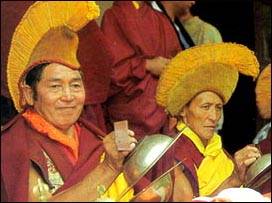 Sani: his picturesque village is 6 kms west of Padum, on the road to Kargil. The chief attraction here is the castle like monastery which, unlike other monasteries of the region, is built on level ground. By legend its initial founding is associated with Kanishka (Kushan ruler of 2nd century AD) on account of the Kanika Stupa which stands in the backyard of the walled complex. The main building comprises a huge multi-columned central prayer hall housing an array of statues of popular Budhist divinities and Drugpa (Old School) high saints. The walls are covered with fescoes and adorned with Thangkas. The most interesting frescoes, however, can be seen in a small, almost discarded chapel at the back of the main building, whose walls are adorned with stucco murals depicting landscapes and floral designs based on the life of Padma-Sambhava. Adjoining this monastic complex is an old cemetry surrounded by a ring of ancient rock-carvings which reflect Indian artistic influence.
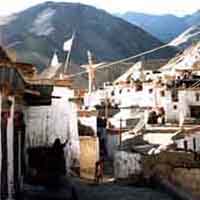 Other places of interest in the Karsha area include an old Nunnery called Dorje Dzong, occupying a hilltop to the west of the main monastery. The ruins around the Nunnery is believed to be the original monastic foundation of Karsha. The present complex was founded during the 14th century. An old Stupa surviving among the ruins is still adorned with the original murals reflecting Indian artistic influence. Nearby the ruins is the old temple of `Chukshik-Jal', housing an exquisite central figures of Avalokitesvara, - the patron deity of Tibet. The smoke covered wall frescos here are the finest example of Himalayan art work.
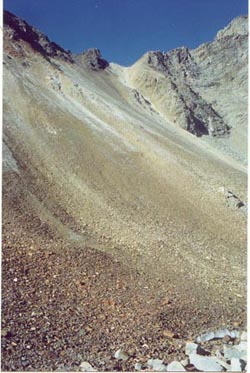 Zangla is a nodal point on the popular Padum-Strongdey-Zangla-Karsha-Padum round trip which covers most of the cultural sites of Zanskar. The old rope suspension bridge spanning the tumultous Zanskar near Zangla-a rare feat of folk engineering is no more in use, but still visible. The river is now crossed by a temporary foot bridge for approaching the left bank along which the trail to Karsha follows. Zangla is also the take-off point for the Padum-Lamayuru and the Padum-Markha valley treks.