| Destinations
|
|||
Bijapur or the city of victory was the capital of the Adilshahi dynasty (1489 to 1686 A.D.). One among the confederacy of five states which saw the eclipse of Hindu rule in the south, the Bijapur kingdom played a significant role in the history of Karnataka by its contribution to art and architecture and by propagating Islam in the land. The city abounds in mosques, mausoleums, palaces and fortifications. These art heritages of Karnataka appear starkly simple when compared to the exuberance of the Chalukyan and Hoysala architecture but are rated as some of the finest Islamic architecture in the world. The main attraction of the city is the well known Golgumbaz. Dominating the landscape of Bijapur is its hemispherical dome, believed to be the world's second largest. Unsupported by pillars, it stands testimony to a major engineering feat. Its acoustical qualities are so phenomenal that a whisper is echoed 12 times over and the slightest sound made by the rustle of a paper carries over a distance of 38 metres. Under the dome lies the tomb of the 7th Adilshahi King Muhammed Adil Shah. His two wives, his mistress, his daughter and his grandson were also buried alongside. |
More on Karnataka • Introduction • Bangalore • Gulbarga • Sravanabelagola • Bidar • Hampi • Mangalore • South West K. • Wildlife Sanctuaries • Bandipur Park • Nagarhole Park
Impressions |
||
Adjoining the Gumbaz is a fine mosque. Nearby is the museum displaying Bijapur carpets. It can be visited on any day of the week between sunrise and sunset. A nominal entrance fee is levied but on Fridays this is also exempt.  Ibrahim Rouza Mehtar Mahal Jami-E-Masjid a large building with a huge shallow dome, Asar Mahal with beautiful fresco paintings, Jal Manzil or the water pavilion, an old mosque formerly a Jain temple, are worth visiting to recall the original beauty of Bijapur. Another interesting object to be seen is Malik-I-Maidan, the legendary cannon of the Adil-shahis. Weighing a solid 55 tons, it was cast in Ahmednagar in 1549 A.D. and sports a muzzle shaped into a lion's head with an elephant being crushed to death between the fangs. Getting to Bijapur With Bijapur as the base, the following places can be visited. Badami Badami which witnessed the promotion of its art and architecture under the Kalyan Chalukyas, the Kalachuryas, the Yadavas of Deogiri, the Vijayanagar empire, the Adil Shahi dynasty and the Marathas has a wealth of inscriptions on Indian history. Among the monuments, the most beautiful ones are two Shiv temples, glorified as Bhuthanatha, God of souls. Set beside a natural pool, the tranquility of the temples is reflected in the moss green of the pool and exudes a freshness similar to the Pallava Shore temple at Mahabalipuram. Badami has a Pallava inscription (642 A.D.) installed during a brief spell of rule by Narasimhavarman. The Archaeological museum at Badami has many interesting sculptures relating to the era among which is Lajja-Gauri a seated goddess with associations of a fertility cult. How to reach Badami Pattadakal The Virupaksha temple, which is an amalgam of the Chalukyan and Pallava styles of architecture has some exceptionally beautiful sculptures. This is also called as the Lokeshwari temple, named after the queen of Vikramaditya II and built in 740 A.D. s it is believed to have been worked on by Pallava artists. A 2.6 m high Nandi in deep green stone faces the temple, which is still in use. While the Papanatha temple is a fusion of southern and northern styles of architecture, the Galaganatha temple resembles the North Indian temples. The Mallikarjuna temple built in the Dravidian style has sculptures depicting the life of Krishna. An old Jain temple containing two stone elephants is also noteworthy. Aihole There are more than 70 structures in Aihole, most of them still in good condition. Kunta temple complex, Ravanaphadi Cave, Meguti temple (dedicated to Mahavira) and a Buddhist temple are a few among them. (Information courtesy Karnataka Tourism Department)
|
|||
 |
|||
Editor: Romola Butalia (c) India Travelogue. All rights reserved. |
|||
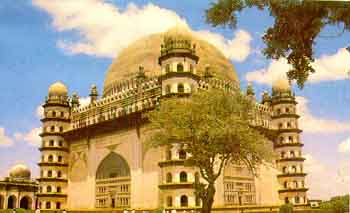 Said to be the inspiration for Taj Mahal, this magnificent monument has the tomb of Ibahim Adil Shah II. Quranic verses are inscribed in gold on the royal tomb.