| Destinations
|
|||
The genesis of Hampi goes back to the age of Ramayana, when it is believed to have been Kishkinda, the great monkey kingdom. Considered sacred, the site was raised to the status of a city in 1336 A.D. by two brothers Hakka and Bukka to consolidate the concept of the Deccab being a Hindu state. The subsequent two centuries saw the Empire of Vijayanagara growing to amazing heights. It attracted international commerce and was known for it's enormous wealth. Hampi owed much of this status to Krishnadevaraya, acknowledged as one of the greatest rulers of the imperial kingdom.
|
More on Karnataka • Introduction • Bangalore • Gulbarga • Sravanabelagola • Bidar • Bijapur • Mangalore • South West K. • Wildlife Sanctuaries • Bandipur Park • Nagarhole Park
Impressions |
||
 In 1565 A.D. Hampi was destroyed by the combined forces of the Deccan Sultans. As history has seen, the destruction of an Empire necessarily means a ruthless assault of it's architecture and culture. The splendid city was pillaged and reduced to shambles within six months.
 At Hampi we see the great temple complexes of the time. The well-planned administrative as well as residential structures, watch towers, aqueducts and baths, along with the fortification of the city are a reminder of a highly developed kingdom and it's culture.  Amidst these ruins stands the Virupaksha temple dedicated to Shiva also known as Virupaksha or Pampapathi. The hall leading to the sanctum sanctorum has finely carved columns with animals. This temple is still in use and the street leading to the temple is still the setting for chariot ceremonies held in February.
The Vithala Temple Hazara Rama Temple
Queen's bath, monolithic Ganesha, Ugra Narasimha, the watch towers are some of the other relics worth visiting in Hampi. How to get there: Air: The nearest airport at Belgaum (259 kms) is connected by Indian Airlines flights to Bombay. Bangalore (325 kms) is linked to most parts of India by air. Rail: Hospet is connected by Broad Gauge line to Bangalore. The overnight Hampi Express leaves Hospet at 8.15 p.m. reaching Bangalore at 6.30 a.m. From Bangalore, the trains departs at 9.30 p.m. and arrives at Hospet at 7.40 a.m. Hospet is also connected by overnight trains to Hyderabad, Thirupathi, Hubli, Margoa (Goa), Badami, Bijapur, Sholapur Vijayawada by meter guage. Road: Regular KSRTC buses ply between Hampi and Bangalore. The tourism department also runs conducted tours covering Hampi, T.B.Dam and Mantralaya. Tungabhadra dam (Information courtesy Karnataka Tourism Department)
|
|||
 |
|||
Editor: Romola Butalia (c) India Travelogue. All rights reserved. |
|||
 Hampi was the 14th century magnificent capital of one of the greatest empires of the world. It is protected by the tempestuous Tungabhadra river on the north and by rocky granite ridges on the three sides. Covering an area of about 26 kms, the ruins are situated in the midst of a rugged landscape.
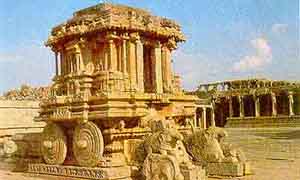
 Situated on southern banks of the Tungabhadra river, the Vithala temple is considered to be a representation of Vijayanagara art. The main pavillion consists of 56 pillars elaborately carved and when struck, emit different musical notes. In its quadrangle stands a magnificent stone chariot, perfectly proportioned with an engineering technology so superb that the stone wheels can rotate.
 The Mahanavami Dibba or the royal seat is yet another striking structure in Hampi. This immense platform was used by the kings to view the Dassehra festivities. It commands an overwhelming view of the royal residences and other ruins of a glorious era. Nearby are the Lotus Mahal and the elephant stables. The Lotus Mahal, a graceful two-storeyed palace is a photographer's delight and is an attractive synthesis of Hindu and Islamic architecture.