| Destinations
|
|||
Your starting point for journeying back in time...
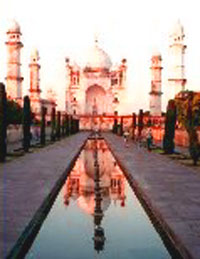
Aurangabad. There is a lilt and rhythm to the name evoking memories of a splendid heritage-for this city was founded as a viceregal capital in the Deccan by the Moghul Emperor Aurangazeb. The fort wall surrounding the city is a poignant reminder of its ancient history. Though the splendour of the 16th and 17th centuries found its finest expressions in the royal monuments of Delhi and Agra, there is enough in Aurangabad to reward the curious visitor. Bibi Ka Maqbara From Persia came the idea of an arched alcove surmounted by a swelling dome, developing its own individual character in India - seen at its height of perfection in the Taj. Bibi Ka Maqbara, the tomb of Begum Rabia Durani, wife of the Emperor Aurangazeb, is a pleasing example of the same idea. It was built by her son in tribute to his beloved mother. Pan Chakki An intriguing water mill dating back to the 17th century. Ingenious engineers channelled and brought down water from a spring on a hill some distance away to generate energy to turn the large grinding stones which served as a flour mill in times gone by. |
Maharashtra • Forts • Panhala • Ajanta & Ellora • Ganapatipule • Hill Stations • Karnala • Borivli
Travelogues • Elephanta Caves • Nature Trail |
||
Hidden in the hills just outside of the city are a cluster of caves probably excavated in the early sixth century. There are Tantric influences evident in the iconography and architectural designs of the caves. Some of the chaitya halls here are constructed on a mandala plan for the circumambulating of the Buddha who is depicted here seated on an intricately carved throne. Excursions Daulatabad This fortress with an amazing history started as an old Hindu stronghold that was captured and plundered in the 13th century. Made the second capital of the Delhi Sultanate a hundred years later, Daulatabad was held as a fine fortress by successive dynasties in the Deccan. Dominated by a great conical hill, Daulatabad commanded a natural pass; artificial scarping made it impregnable. The Chand Minar, a 30 m. high minaret with three circular galleries, looked down over the approach from the north and east and had a defensive as well as religious role in this fortress. Khuldabad A few kilometres from Daulatabad is the austere, plastered masonry monument that commemorates the memory of Aurangazeb who directed that his tomb should be the simplest possible.  Ghrishneshwar Temple Less than half a kilometre from Ellora is the Ghrishneshwar Temple; one of the Jyotirlingas of Maharashtra. Pithalkora 78 kms from Aurangabad, on the ancient trade route linking Ajanta and Ellora and progressing to the coast, is a group of 13 cave sanctuaries -- chaityas and viharas -- dating back to the second century B.C. with additions in the fifth and sixth centuries. The beautiful sculptured facade of the great vihara (cave 4) still impresses though it has largely crumbled away. The relief work in Pithalkora is richer and more elaborate, the carving more precise, than at other early sites. Paithan The ancient city and pilgrimage centre of Paithan is situated on the banks of the Godavari, 56 kms. south of Aurangabad. The Marathi poet-saint Ekanath lived here and several centuries ago Paithan was famous as a seat of learning. It is also well-known for the beautiful 'Pathanis' -- silk sarees with intricate zari borders. Of special interest to nature lovers are the gardens around the Jayak Wadi Dam nearby where observation points enable you to watch resident and migratory birds. Getting there
The Deccan city of Aurangabad is a convenient base for visiting its ancient environs. It is accessible by air, rail and road from Bombay & Delhi. By Air: Aurangabad airport is 10km. from the city and is airlinked directly to Delhi and Bombay. By Rail: Aurangabad is a section on the Manmad - Kachiguda line on SCR. Passengers from Bombay and Delhi change at Manmad railway Junction, 114km. away from Aurangabad. Bombay-Aurangabad (via Manmad) 375km. Delhi-Aurangabad (via Agra, Gwalior, Jhansi, Bhusawal, Manmad) 1395km. Jalgaon, a railhead on CR, is only 59 kms. from Ajanta. By Road: Bombay-Aurangabad is 388km. (via Mumbai) Bombay-Aurangabad is 400km. (via Pune). Delhi-Aurangabad is 1323km. (via Mathura, Agra, Gwalior, Shivpuri, Indore, Dhule, Jalgaon, Ajanta). S.T. buses run from Bombay, Pune, Ahmednagar, Jalgaon, Shirdi, Nasik & Dhule to Aurangabad, and from Jalgaon to Ajanta. MTDC operates daily bus services and conducted tours from Bombay to Aurangabad by luxury coach. Information: Courtesy Government of India |
|||
 |
|||
Editor: Romola Butalia (c) India Travelogue. All rights reserved. |
|||
 Aurangabad Caves