| Destinations
|
|||
The name "Assam" is derived from the term "Asom" which, in Sanskrit, refers to unequal or unrivalled. The uneven topography of the land, full of hills, plains and rivers might, therefore, have contributed to her name. A land of about 25 million people the principal language of Assam is Assamese although a large number of other languages are spoken.
Assam, the land of hills and valleys, the land of the mighty river Brahmaputra, the land of Mother Goddess Kamakhya, lies in the northeastern corner of India. It is a land where you find flowers that are exquisitely beautiful, animals that are rare, and a beleagured people that are proud and hospitable. Bihu is the national festival of Assam. The principal of the three Bihus, Bohag or Rongali Bihu ushers in the Assamese New Year, in the middle of April, and is celebrated with distinctive Bihu dances and songs. Guwahati |
More on North East • More on Assam • Arunachal Pradesh • Manipur • Meghalaya • Mizoram • Nagaland • Tripura
Travelogues |
||
Kaziranga National Park
A wide variety of snakes including the rock python and the monitor lizard are also found here. Amongst the birds, the crested serpent eagle is common while palla's fishing eagle and gray headed fishing eagle are frequently seen. Others include the Great Adjutant Stork, crane, Bengal floricab, bar-headed goose, whistling teal, and pelican.  Mihimukh is the starting area for the park and elephants can be hired from here to enter the sanctuary. Jeep safaris and early morning elephant rides can be arranged for at the Tourist Centre here. Forest rest houses and bungalows are available in the park area. Kaziranga Forest Lodge is also available with air conditioned rooms, bar restaurant and other facilities. Contact
Tezpur Sibsagar Haflong Jorhat Dibrugarh |
|||
 |
|||
Editor: Romola Butalia (c) India Travelogue. All rights reserved. |
|||
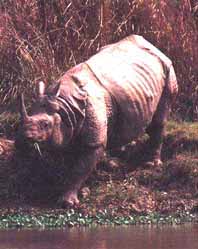 Kaziranga is famous for the great One-Horned Rhinos. Tigers which are natural enemies of rhinos are also there in sizable numbers in this area. Other attractions of this national park include the wild buffalo, magnificent swamp deer, hog deer, wild boar, Hoolok gibbon, capped langur and ratel (badger).
 mythology, legend and folklore.Tezpur or the 'city of blood' conjures up images of the romantic legend of Usha and Anirudha. Situated on the banks of river Brahmaputra, this town replete with a raw natural beauty and fascinating archaeological ruins is the headquarters of district Sonitpur.Undulating green valleys surrounded by lofty hills and the snow-capped peaks of the Himalayas, and lush tea gardens make Tezpur a tourist's delight.
 It is famous for its sprawling tea gardens. It is the nerve centre of the tea industry. It has the world renowned Teklai Experimental Centre. Research is carried out to find new varieties of tea and also therapeutic effects of green tea. From Jorhat, one can visit Majuli, the largest island on the Brahmaputra. In Majuli, there are numerous satras or monasteries. 60 kms aways from Jorhat, lies Nambar Forest reserve which is famous for being a rejuvenating hot spring.A further 90 kms down, one comes across Dimapur (in Nagaland), once the seat of the Cachar kingdom.