| Destinations
| |||
 Orissa is a maritime state, on the east coast of India, between the states of West Bengal and Andhra Pradesh. Its location is between 17 degrees 49 minutes North to twenty two degrees thirty four minutes North latitudes and 81 degrees 27 minutes East to 87 degrees 29 minutes East longitudes. Morphologically, Orissa can be divided into five parts:
The coastal plains of Orissa stretch from Subarnarekha in the north to Rushikulya in the south. The mountainous region of Orissa covers about 3/4 of the area of the state. This region is a part of the Indian peninsula. Here deep and broad valleys are cut by the rivers. The rolling uplands are lower in elevation than the plateaus. They vary from 153 m to 305 m. They are products of continued river action, are rich in social nutrients. The monotony of topography is interrupted by the river valleys, which are not a product of the action of the rivers. It is a fertile, undulated topography. The subdued plateaus range from 350 m to 610 m. |
More About Orissa • An Overview • History • Culture
Places to Visit
Travelogues
Leisure |
||
 Out of the total area of Orissa, a little more than twenty percent of it is covered by forests of various types. There is the sal, piasal, sanghan, rosewood, ghambari, rosewood and haldi. Growth of the forests accounts for a widespread habitat for various species of wild animals. Tigers, leopards, wolves are found in almost all districts. Elephant is another wild animal for which Orissa is famous. Indigenous quail, hare and black partridges are found in scrub jungles. Peacocks, jungle fowls and wild ducks are also normally seen. In the creeks, crocodiles and alligators are a source of fear to the people. Fish of various kinds, prawns and oysters are found in the sea waters. Climate The summer temperature ranges between 27 degrees centigrade and 49 degrees centigrade and in winter ranges between 4.4 degrees centigrade and 15.6 degrees centigrade. Compiled by Pallavi Bhattacharya |
|||
 |
|||
Editor: Romola Butalia (c) India Travelogue. All rights reserved. |
|||
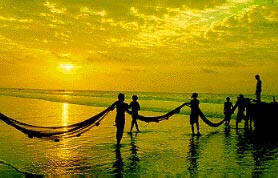 Orissa has many rivers, lakes, waterfalls, hot springs and hills. The important peaks of the Orissan hills and mountains are Meghasan, Gandhamardan, Deomali, Sinkram, Malaygiri, Mankadnacha, Panchadhara,Srungaraj, Mahendragiri, Nimnagiri and Bakasham. The important rivers are Mahanadi, Brahmani, Baitarini, Budhabalanga, Subarnarekha, Salandi,Rushikulya, Bansadhara, Bada, Bahuda and the Indravati. The biggest lake in Orissa is the Chilika Lake near the Bay of Bengal.
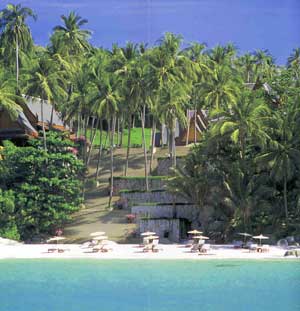 There are three well-marked seasons in the State. They are summer, rainy season and winter. The summer continues from March till June when the temperature rises very high. There are occasional showers during this season. The rainy season continues from July to October and there is heavy rainfall in the month of August. Winter starts in November and continues till February and is severe except in some areas of Phulbani and Koraput districts. There are thundershowers in the southern and western parts of the state during winter.