| Destinations
| |||
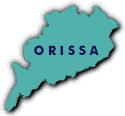 The total population of Orissa is 31,659,736. The decadal growth rate is 20.06%. The density per square km is 203. Sex ratio: 971 females per 1,000 males. The literacy rate is 40.09%. More than 80% of people live in picturesque villages nestling among palm trees and mango groves. They decorate their cottages with lovely murals in white. Their motifs are derived from the life they see around - sheaves of paddy, caparisoned elephants, sinewy tigers, and the magnificent temples which dominate Orissa's landscape. Normally, the dhoti an unstitched garment, about 4.5 m in length and the chadar adorn their bodies. There is grace and rhythm in whatever they do, whether carrying loads, cultivating their fields or putting their boats to sea. About 24% of Orissa's population is tribal. The western part of northern Orissa centres has a large population of aborigines, the adivasis. The most important among the tribes are Bhuiyan, Munda, Oraon, Santal, Gond, Kandh, Ho, Juang, Paroja, Savara, Sudha, Binijhal and Bhumiji. The greatest concentration is found in the districts of Koraput, Mayurbhanj, Sundergarh and Ganjam. Each tribe has a distinct language and culture of its own, so that the socio-economic pattern of living varies from tribe to tribe and from region to region. The economic life of the tribes of Orissa centre round pursuits ranging from hunting and food gathering to shifting cultivation. |
More About Orissa • An Overview • History • Geography
Places to Visit
Travelogues
Leisure |
||
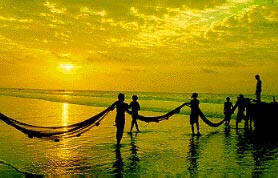 Most tribes, however combine a number of occupations with specific emphasis on one. With economic development, many among the tribes have abandoned their age old economic pursuits and taken to the modern ways of making a living.
Throughout its history, people from different parts of the country have come and settled in Orissa. Oriyas, the people of Orissa, therefore represent a blend of various elements, as indeed people do in other parts of India. Although there are many languages and dialects spoken in Orissa, 12 languages are important. The language distribution is as follows: Oriya - 84.11%, Telegu - 2.28%, Santali - 1.69%, Kuli - 1.60%, Bengali - 1.51%, Urdu - 1.31%, Ho - 0.97%, Kondha - 0.89%, Hindi -0.88%, Savara - 0.72%, Mundari - 0.53%, Others - 3.51%. Hinduism is the main religion. Buddhism and Jainism are of historic importance but today have become minority religions with Islam and Christianity. There are several ancient temples of the Saivite and Vaishnavite sects of Hinduism.  The Oriyas take pride in the superb artistic skills displayed in their temples, handicrafts, paintings, music and dance of the Orissa style.
Orissa's folk tradition of performing arts are of three types - songs, ballads and Jatra. Folk-songs are sung in fields of work; while some are in the form of ballads are riddles. A ballad is predominantly melancholy, sung to the accompaniment of flutes and lyres. Orissa is the only state whose history starts with genuine documentary records of historic arts such as dances, combats, music, orchestras, festivals and plays. One of the foremost is the puppet theatre: string and rod puppetry, and shadow puppetry. Three of the important solo performances are Galpasagara, the Kathaka and the Harikatha. Dasakatha is a unique show involving two artists. Chhau Nata is internationally known for its vivacity and colourful masks. The Danda Nata is devotional in form. Themes from Mahabharata find a place in Dwari Nata, a very popular theme. Dance and music are also an important part of the cultural heritage for many Orissans. Orissan music is known for its unique rhythm. The tribal dancers wear elaborate costumes when performing the dances. The dance that originated in Orissa is known as the Odissi. Odissi, has often been described as sculpted motion with postures that reflect the temple statues of Orissa.
The handicrafts of Orissa include silver filigree, horn work, metalwork, stoneware , ivory wood work, paddy craft, lacqerware, golden grass work, cane and bamboo, wood carving, wooden painted toys, palm leaf etching, clay toys, solapith work, jewellery, dhokra casting, jari work, jaikhadi work, cloth flower garland, artisic footwear, keora leaf work, art leather crafts, carpets, banana fibre work, tin toys, shell work, sabai grass work, feather work, appliqué work and patta chitra, an ancient and unique craft of folk painting. Compiled by Pallavi Bhattacharya |
|||
 |
|||
Editor: Romola Butalia (c) India Travelogue. All rights reserved. |
|||
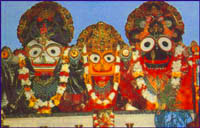 Painting in Orissa has followed the murals and engravings on the temples. All the three main categories of Orissan paintings, the Bhitt Chitra or the murals, the Pata or the cloth painting and Talapatrachitra or the palm-leaf engravings, remain more or less in the same style and subject manner.
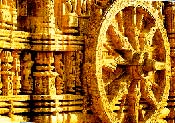 Orissa has some of the most famous and elaborate temples in the world. A typical temple is of sandstone and consists of two essential structures, the duel and the jagamohan. Occasionally, one or two more structures, such as natamandir (dance hall) and bhogmandir (hall of offerings) were added in front of the jagamohan. The Jagannath Temple (Puri), Sun Temple (Konarak), Lingaraja Temple, Mukteswar Temple are breath-taking in their architecture.