| Destinations
|
|||||||||||||||
Ajmer situated about 135 km southwest of Jaipur, is the most sacred of all Muslim places of pilgrimage in India. Founded by Raja Ajay Pal Chauhan in the 7th Century A.D, the city was lost to Mohammad Ghori after he defeated the valiant Prithviraj Chauhan in 1193 A.D. Since then, Ajmer became home to many dynasties, which left behind indelible marks of their culture and tradition on the city's history, converting it to an amalgam of various cultures and blend of Hinduism and Islam. Today, Ajmer is a popular pilgrimage centre for Hindus as well as Muslims. Especially famous is the Dargah Shareif or tomb of the Sufi saint Khwaja Moinuddin Chisti, which is equally revered by both Hindus and Muslims. Ajmer is also the base for visiting Pushkar (11 km.), the abode of Lord Brahma, lying to its west, with a temple and a picturesque lake. The Pushkar Lake is a sacred spot for Hindus. During the month of Kartik (Oct./Nov.), devotees throng in large numbers here to take a dip in the sacred lake.
Landmarks Khwaja Moinuddin Chisti's Dargah
|
More on Rajasthan • History • Geography • People & Culture • Economy • Festivals • Wild Life • Adventure • Climate Cities • Alwar • Bharatpur • Bikaner • Chittaurgarh • Jaipur • Jaisalmer • Jodhpur • Kota • Mount Abu • Ranakpur • Sariska • Udaipur
Travelogues
Impressions | ||||||||||||||
 The saint's tomb with a splendid marble dome is in the centre of the second courtyard, which is surrounded by a silver platform. Horseshoes, offerings from horse dealers are nailed to the shrine doors. The shrine attracts thousands of pilgrims during the Urs-commemorating the death anniversary of the Saint, held from the 1st to the 6th day of the Islamic month of Rajab. During the celebrations, the devotees' food is cooked in two enormous degs (cauldrons), one of them nearly 10 feet in diameter, and then follows the ritual of "looting the degs". After emptying them at lightening speed, attendants jump inside the steaming hot interiors to scrape out the dregs in less than 5 minutes. A colourful fair that springs up during this time is another major attraction. Shahjahan's Mosque In the corner of the inner court of the Dargah, is a magnificent building in white marble with a long (30.5m) and narrow court having a low arcade and delicate carvings with trellis work. It is the most marvellous of all the sanctums within the sanctuary of the Dargah.
Taragarh Fort The Taragarh Fort, perched on a hill provides an excellent view of the city. A steep one and a half hour climb beyond the Adhai-din-ka-jhopra leads to the ruins of this fort, which was the site of the military activity during the Mughal period, and later used as a sanatorium by the British.
The Museum Once the royal residence of Emperor Akbar, the museum houses a rich repository of the Mughal and Rajput armour and exquisite sculptures.Mayo College 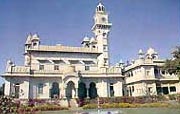 Once described as "the Eton of the east", it is one of India's best public
schools. Located in the southeast of Ana Sagar, the institute used to
provide education to children of the royal families, but now anyone can
study here. The lake, the cenotaph and the shrine of the Hindu reformer
Swami Dayanand, founder of the Arya Samaj movement in India, can be viewed
from here.
Once described as "the Eton of the east", it is one of India's best public
schools. Located in the southeast of Ana Sagar, the institute used to
provide education to children of the royal families, but now anyone can
study here. The lake, the cenotaph and the shrine of the Hindu reformer
Swami Dayanand, founder of the Arya Samaj movement in India, can be viewed
from here.
Pushkar Lake (11km) The Lake is situated on the edge of the desert and is surrounded by hills on three sides, while being separated from Ajmer by 'Nag Pahar'-the snake mountain. On this mountain the Panchkund and the cave of the saint Agastya are located. It is believed that Kalidas-the 4th century Sanskrit poet and playwright chose this forest hermitage as the setting for his masterpiece
Abhigyanam Shakuntalam According to legend, the origin of Pushkar dates back to the time when lord Brahma was in search of a tranquil land to perform a Yagna. A lotus fell from the hands of the lord into this valley. A lake sprang up at this spot and was dedicated to him. A Brahma temple located here is a popular place of pilgrimage. On the full moon of Kartik (around Nov) pilgrims take a holy dip in the lake.Pushkar Fair It is one of the most colourful fairs of India. Scores of pilgrims throng the lake during the annual cattle fair. Besides trading of horses, camels, cows and bulls, there are exciting camel-cart races, street theatre and a bundle of stalls selling handicrafts. Musicians, mystics, comedians, tourists, traders, animals and devotees all converge to Pushkar during the fair. Clothes, household items and leather goods are up for sale during the fair. Pushkar's bazaar is especially good for costume jewellery and embroidered fabrics- an ideal place for picking up souvenirs.Ana Sagar This artificial lake was created in the 12th century by damming the River Luni. Daulat Bagh, on the banks of the river contains a series of marble pavilions erected in 1673 by Shahjahan. There are fine views from the hillside beside the Daulat Bagh. At Ana Sagar jetty and paddleboats can be hired. The lake tends to dry up if the monsoon is poor, so the city's water supply is taken from Foy Sagar, 3 km farther up the valley.
Man Mahal Along the banks of the Pushkar Lake is Man Mahal, the former residence of Raja Man Singh of Amer. Presently converted to RTDC's Sarover Tourist Bungalow it provides convenient accommodation to travellers. Adjoining the Man Mahal is the Pushkar Palace (Kishangarh House), a heritage hotel.Foy Sagar (5km) A picturesque artificial lake named after the engineer, who created it under a famine relief project.General Information Accommodation Mansingh Palace is the only luxury hotel in Ajmer. Hotel Regency, Hotel Embassy and Hotel Samrat are some mid range hotels. Aravali Holiday resort, RTDC's Hotel Khadim and the Nagpal Tourist Hotel are the mid-range options. King Edward Memorial Rest House and Hill Top Cottage are some budget options. Places to Eat Sheesh Mahal at Mansingh palace and the Tandoor Restaurant reputedly offer the best meals in town. Bhola Hotel and Honey Dew restaurant with its wide variety of veg and non- veg food, Indian and Continental cuisine are affordable places to eat. How to get There Air : Jaipur, 132 km, is the nearest airport. Rail : Regular train services link Ajmer with important cities. Some important train connections are: Gujarat Mail (Mumbai-Ajmer-Delhi Sarai Rohilla); Jodhpur Mail (Marwar-Ajmer-Jaipur) : Delhi Express (Ahmedabad-Ajmer-Jaipur); Shatabadi Express (New Delhi-Ajmer-New Delhi). Road : A good network of bus services operate from Ajmer to key destinations around. Local Transport: City bus service operates in the city and to Pushkar. Unmetered taxis, auto-rickshaws, tongas, and cycle-rickshaws are also available. Shopping Shopping in Ajmer is an enjoyable experience. One can shop for antiques, curios, fascinating gold and silver jewellery in contemporary designs, colourful tie-and-dye sarees and embroidered jodhpuri 'Jutis'. Especially during the annual Urs fair, a range of colourful items and marvellous creations of traditional folk artisans are for sale. Altitude : 486 meters Climate : Max. Min. Summer: 38.1 deg C 27.7 deg C; Winter: 23.3 deg C to 5.5 deg C Clothing : Summer Light Tropical; Winter: Woollen Best Season:: July-March Languages : Rajasthani, Hindi, Urdu, English, Sindhi.
|
|||||||||||||||
 |
|||||||||||||||
Editor: Romola Butalia (c) India Travelogue. All rights reserved. |
|||||||||||||||
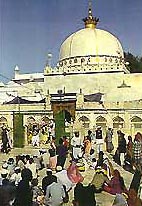 At the foot of an arid hill is situated India's most important pilgrimage centre for people from all faiths. It is the splendid tomb of the Sufi
saint Khwaja Moinuddin Chisti, more popularly known as Khwaja Sahib or
Khwaja Shareif, who came to Ajmer from Persia in 1192 AD. The shrine is
next only to Mecca or Medina for the Muslims of south Asia. Akbar used to
make a pilgrimage to the Dargah from Agra once a year.
At the foot of an arid hill is situated India's most important pilgrimage centre for people from all faiths. It is the splendid tomb of the Sufi
saint Khwaja Moinuddin Chisti, more popularly known as Khwaja Sahib or
Khwaja Shareif, who came to Ajmer from Persia in 1192 AD. The shrine is
next only to Mecca or Medina for the Muslims of south Asia. Akbar used to
make a pilgrimage to the Dargah from Agra once a year.