| Destinations
|
|||||||||||||||
In 1488 AD, a Rathore prince Rao Bikaji, a descendant of the founder of Jodhpur, transformed a barren piece of land called Jangladesh, into an impressive city and christened it Bikaner after his own name. The sandy dunes of north Rajasthan extend to the royal city of Bikaner. Circumscribed by a seven km long embattled wall with five gates, Bikaner retains the timeless appeal of medieval grandeur that infuses the city's lifestyle. The most important source of water in Bikaner is its wells, which are built on high plinths with slender minaret towers on each of the four corners. Noticed even from a distance, the wells are an attraction to tourists. The ship of the desert, the camel, is an inseparable part of life here. Popularly called camel country, the city is renowned for the best riding camels in the world that are also prime helpers used for pulling heavy carts, transporting grains, working on wells and even camel safaris. Delicately created in pink sandstone, the imposing forts and palaces bear testimony to its rich historical and architectural benefaction. Strategically located on the ancient caravan routes that came from west/central Asia, Bikaner became a prime trade centre in the times of yore. Undulating lanes, colourful bazaars and cheerful people make Bikaner an interesting and unusual experience. |
More on Rajasthan • History • Geography • People & Culture • Economy • Festivals • Wild Life • Adventure • Tourist Information • Accommodation • Climate Cities • Ajmer Shareif • Alwar • Bharatpur • Chittaurgarh • Jaipur • Jaisalmer • Jodhpur • Kota • Mount Abu • Ranakpur • Sariska • Udaipur
Travelogues
Impressions | ||||||||||||||
Junagarh
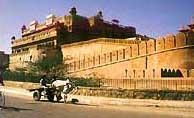
Built in 1593 AD by Raja Rai Singh, a general in the army of Emperor Akbar, Junagarh is unusual because unlike other major forts which are built on hill tops, it was built on the desert plains itself. A formidable structure encircled by a moat it has some beautiful palaces within. The Suraj Pol or Sun Gate is the main entrance to the fort. The palace complex's artistically and intricately decorated interiors are better preserved than in almost any other region. Anup Mahal, with its ornately lacquered walls in red and gold with panels of dazzling coloured glass inlay set over the coronation throne, is worth admiration. The marble columns are covered with delicate paint work, and leaves a visitor spellbound. In artist was specially commissioned to paint the Badal Mahal, so that when the rare phenomena of rains occurred, the children of the royal household would not get frightened. The exquisitely beautiful Chandra Mahal or the Moon Palace with marvellous paintings, mirrors and carved marble panels, and the Phool Mahal or Flower Palace ornate with glass and mirror work are worth a visit. Other items of interest include an unusual Rajput weapon collection and an old WW I biplane presented to Maharaja Ganga Singh by the British. The Har Mandir It is the majestic chapel for the royal family for worshipping their gods and goddesses.  Lal Garh Palace
Built by Maharaja Ganga Singh in the memory of his father, Maharaja Lal
Camel Research Farm(8 km) Set amid rolling sand dunes, this farm was set up to produce superior strains of camels both for domestic haulage as well as, even today, for military use. The only one of its kind in Asia, this farm extends over 2000 acres of semi arid land and is managed by the Central Government. Interestingly, one of the efforts is to breed camels with longer, thicker eyelashes to offer greater protection during sandstorms.
Devi Kund (8 km) Built in the memory of the Bika dynasty rulers this royal crematorium has several ornamented cenotaphs. Maharaja Suraj Singh's chhatri is the most impressive of all, created entirely in white marble with spectacular Rajput painting on the ceiling. from here.Gajner Wildlife Sanctuary(32 km) A beautiful painting and a bronze Nandi facing the Shiva Lingam, is the most impressive feature of this late 19th century temple.Deshnok's Karni Mata Temple(30 km) Located on the Jodhpur road the temple is dedicated to Karni Mata, an incarnation of Goddess Durga. The temple has huge intricately carved silver gates, which were donated by Maharaja Ganga Singh. Thousands of rats scamper freely within the sanctum sanctorum of the temple. Regarded as incarnations of mystics, they are fed by priests and devotees because of the belief that the rats will reincarnate as holy men. Spotting a white rat is considered an omen of good fortune.
Kalibangan(205 km) The extensive remains of the pre-Harappan and Harappan civilisations, found here in Hanumangarh district, are of immense interest to archaeology enthusiasts.General Information Accommodation Hotel Bhanwar Niwas in the Rampur Haveli has rooms built around a courtyard and is an excellent choice. Lalgarh Palace Hotel with its bar, billiards room, pool and resident astrologer is part of the maharaja's modern palace. Hotel Harasar Haveli with its traditional fire dance performances, the Bhairon Vilas and Hotel Padmini Niwas are some mid range hotels in Bikaner. Hotel Meghsar Castle, RTDC's Hotel Dhola Maru, and Hotel Desert Winds are part of the numerous budget options to stay. Places to Eat Hotel Bhanwar Niwas, Lalgarh Palace Hotel, Deluxe restaurant and Amber Restaurant are places to check out. Bikaner is noted for its namkin (spicy snacks) which are available along the Station Road. Check out the Chhotu Motu Joshi Sweet Shop, which offers an assortment of Indian sweets. How to get There Rail : Bikaner is linked by rail to Jaipur, Jodhpur and Delhi. Road : Frequent ordinary and express buses to most tourist places in Rajasthan are available at the bus stand. Shopping Abhivyakti, a small craft shop run by the Urmul Trust, offers high quality items made by locals from the surrounding villages. Proceeds from here go to health and education projects of these villages. The traditional usta (camel leather) products are available at Usha Street in the old city. Climate : Summer: 41.8 degree C 28.0 degree C Winter: 23.2 degree C 5.0 degree C Best Season:: October to March Clothing :Summer Light Tropical; Winter Woollen Languages : Rajasthani, Hindi, English. |
|||||||||||||||
 |
|||||||||||||||
Editor: Romola Butalia (c) India Travelogue. All rights reserved. |
|||||||||||||||
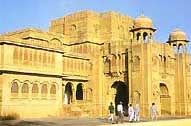 Singh, the red palace with overhanging balconies and latticework make it
an imposing structure. Sprawling lawns with blooming bougainvillaea and
dancing peacocks render it a breathtaking visual treat. Part of the palace
has been converted into a luxury hotel and a museum, Shri Sadul Museum.
The museum covers the entire first floor of the palace and houses well
preserved old photographs of the maharajas, their personal belongings,
trophies of wildlife and a carriage from the maharaja's royal train.
Singh, the red palace with overhanging balconies and latticework make it
an imposing structure. Sprawling lawns with blooming bougainvillaea and
dancing peacocks render it a breathtaking visual treat. Part of the palace
has been converted into a luxury hotel and a museum, Shri Sadul Museum.
The museum covers the entire first floor of the palace and houses well
preserved old photographs of the maharajas, their personal belongings,
trophies of wildlife and a carriage from the maharaja's royal train.