| Tamil Nadu Economy |
|||||||||
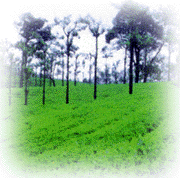
The main food crops are rice, pulses and oil seeds. Important commercial crops that are grown in Tamil Nadu include sugarcane, cotton, tea, rubber, cashew and coconut. Major forest products are timber, sandalwood, pulpwood and fuel wood while the minor products include bamboo, eucalyptus, rubber, tea, cashew, honey and ivory. |
About Tamil Nadu • Overview • Geography • People • Economy • Festivals • Climate Cities • Ooty • Chennai • Madurai • Kodaikanal • Kanniyakumari Travelogues • Sapphire God • Hampi • Nisargadama
|
||||||||
Improved port facilities and the effective use of electric
power resources have helped industrial development in Tamil
Nadu. Cotton ginning, spinning and weaving continue to be the
major industries, followed by the production of automobiles,
motorcycles, diesel engines, sugar, agricultural implements,
fertilizers, cement, iron & steel, paper, chemicals,
transformers and electric motors.

Tamil Nadu is rich in handicrafts; notable among them are handloom silk, metal icons, leather work, kalamkari (hand-painted fabric, using natural dyes), brass, bronze, copper wares, carved wood, palm leaf and cane articles. The state is an important exporter of tanned skin, hides, leather goods, cotton goods and yarn, tea, coffee, spices, engineering goods, tobacco, handicrafts and black granite.
|
|||||||||
 |
|||||||||
Editor: Romola Butalia (c) India Travelogue. All rights reserved. |
|||||||||
 With agriculture as the prime occupation, agricultural practices have
undergone radical improvement since independence. Tamil farmers conserve scarce rainwater in small and large
irrigation reservoirs or tanks. Government canals, tube wells
and ordinary wells also form part of the irrigation system.
Several river valley projects in the state depend on the
erratic northeast monsoon for water. Consequently, subsoil
water sources are being tapped. Multiple
cropping, the use of new and better strains of rice, cotton,
sugar, and millet, and the use of chemical fertilizers have
been widely adopted. By 1967, the state was self-sufficient in
the production of food grains.
With agriculture as the prime occupation, agricultural practices have
undergone radical improvement since independence. Tamil farmers conserve scarce rainwater in small and large
irrigation reservoirs or tanks. Government canals, tube wells
and ordinary wells also form part of the irrigation system.
Several river valley projects in the state depend on the
erratic northeast monsoon for water. Consequently, subsoil
water sources are being tapped. Multiple
cropping, the use of new and better strains of rice, cotton,
sugar, and millet, and the use of chemical fertilizers have
been widely adopted. By 1967, the state was self-sufficient in
the production of food grains.