| Tamil Nadu Madurai |
|||||||||
Situated on the banks of river Vaigai, Madurai is the second largest city of Tamil Nadu. Known as the Athens of the East, Madurai was an important cultural and commercial centre even as early as 550 AD and the capital city for the great Pandya kings. The city is more than 2,500 years old and has a rich cultural heritage and history. The beautiful Goddess, Meenakshi with her lovely fish-shaped eyes, together with her consort, the Lord Sundareswar or Shiva, presides in her magnificent temple in the heart of the town. On a normal day, an estimated 10,000 people visit the temple. Madurai is surrounded by several mountains. It is famous for jasmine flowers, which are transported to other cities of India and abroad. Apart from the medieval atmosphere of the temple and its surroundings, Madurai is a busy modern city engaged in commerce.
Legend |
About Tamil Nadu • Geography • History • People • Economy • Festivals • Climate Cities • Ooty • Chennai • Kodaikanal • Kanniyakumari Travelogues • Sapphire God • Hampi • Nisargadama
|
||||||||
Apart from a brief period when it fell to the Cholas, Madurai remained with the Pandyas until the decline of the empire. Pandyan kings patronised Tamil language in a great way. During their period, many masterpieces were created. "Silapathikaram", the great epic in Tamil was written based on the story of Kannagi who burnt Madurai as a result of the injustice caused to her husband Kovalan. 
The next major rulers of Madurai were the Vijayanagara kings who won over the territory in 1371. They appointed the Nayaks as governors who, in time became powerful in their own right. The 200 - year old reign of the Nayaks marks the golden period of Madurai when art, architecture and learning scaled new heights. In fact, the most beautiful buildings in the city including its most famous landmark, the Meenakshi temple, are Nayak contributions. Among Nayaks, Thirumalai Nayak (1623-1659) was very popular since it was he who contributed to the creation of many magnificent structures in and around Madurai. The Raja Gopuram of the Meenakshi Amman Temple, The Pudu Mandapam and The Thirumalai Nayakar's Palace are living monuments to his artistic fervor. Madurai passed on to the East India Company in 1781 with George Procter as the first collector of Madurai. In 1840, the Company razed the fort, which had previously surrounded the city, and filled in the moat. Four streets known as Veli streets, which were constructed on top of the fill, till today, define the limits of the old city. After India's independence, Madurai is one of the major districts of Tamil Nadu with 15 State Assembly and two parliament constituencies. Landmarks
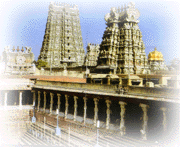
Meenakshi Temple Located at the heart of the city, the Meenakshi-Sundareshwar temple has long been the focus of both Indian and international tourist attraction as well as one of the most important places of Hindu pilgrimage. People of the city wake up to the chant of hymns at the temple, which is the very centre of their cultural and religious life. While the major festivals of Tamil Nadu are celebrated here with gaiety that equals the rest of the state, the most important moment in Madurai is the Chitrai festival that is held in April/May, when the celestial marriage of Meenakshi and Sundareshwar is celebrated, drawing a huge crowd of people from all over the state. Of its 12 gopurams, four of the tallest stand at the outer walls of the temple. The 48.4m high southern gopuram is the most spectacular and has over 1500 sculptures. From its top, it is possible to obtain a panoramic view of the city. The Rajagopuram on the eastern side is an unfinished structure, which has a 174 sq. ft base and had this tower been completed, it would surely have been the largest of its kind in the country. The eight smaller gopurams are within the compounds of the twin temples. The Ashta Shakti Mandapam was built by Thirumalai Nayak's wives Rudrapathi Ammal and Tholimamai. In this hall food is distributed to the devotees who come from far off places. The sculpted pillars of this mandapam tell the story of the beautiful princess of Madurai and her marriage to Lord Siva. Meenakshi was the daughter of King Malayadwaja Pandya and Queen Kanchanamala, who begot her after performing several yagnas (sacrificial rites). The three-year old girl who emerged out of the fire during the final yagna was found to have three breasts but a divine voice informed the surprised royal couple that the third breast would disappear when the girl meets her consort. The princess, who was named Meenakshi, grew to be a beautiful young woman of great valour who conquered several lands and challenged the mightiest kings including Indra, the King of the Devas. Indra appealed to Lord Siva for protection and Meenakshi, chasing the fleeing king, confronted Siva whereby her third breast disappeared. It was revealed that the princess was actually an incarnation of Parvati who came to earth to honour a promise given to Kanchanamala in her previous life. Thus Siva came to Madurai as Sundareshwar to marry Meenakshi and the two ruled over the kingdom for many years before they left for their heavenly abode from the spot where the temple now stands. The Portamaraikulam or the golden lotus tank is the place where the Tamil literary society called Sangam used to meet to decide the merit of the literary works presented to them. The manuscripts that sank were dismissed while those that floated were considered to be great works of literature. A pillared corridor surrounds the tank. Steps lead down to the tank, enabling worshippers to bathe in it. The Oonjal (swing) Mandapam and Killikoontu (parrot cage) Mandapam are on the western side of the tank. Every Friday the golden idols of Meenakshi and Sundareshwar are seated on the swing in the Oonjal Mandapam and hymns are sung as the deities swing to and fro. Next to this mandapam is the Kilikootu Mandapam or hall of parrots where there are some beautiful sculptures as well as parrots, which chant the name of Meenakshi. But more interesting are the 28 pillars of the mandapam, which exhibit some excellent sculptures of figures from Hindu mythology. The shrine to the goddess is just beyond this hall and entry is restricted only to Hindus. At the Sundareshwar temple across the courtyard, Lord Siva is represented as a lingam and here too, entry is restricted. On your way you can worship a gigantic idol of Sri Ganesh called Mukkurini Pillaiyar. The corridor outside the shrine has the stump of a tree under which Indra is believed to have worshipped a lingam. In the Kambathadi Mandapam there is a unique idol of Nataraja dancing with his right leg raised to the shoulder instead of the other way round. This idol of Nataraja is covered with silver leaves. Hence this hall is named as Velli Ambalam (Silver Hall). The pillars of the Mandapam are decorated with scenes from the wedding of Meenakshi and Sundareshwar, many of which depict Shiva and Vishnu together, the latter having come to give Meenakshi away in marriage. The temple museum is housed in the hall with 985 richly carved pillars each one surpassing the other in beauty. More scenes from the wedding can be seen in the Vasantha Mandapam or Pudhu Mandapam. Icons, photographs and drawings exhibiting the 1200 years old history of the temple can be seen in the museum. It was constructed by Tirumalai Nayak and is used during the celebration of the spring festival in April-May. Just outside this mandapam, towards the west, are the Musical Pillars. Each pillar when stuck produces a different musical note. Vandiyur Mariamman Teppakulam There are few temples in India, which share the grandeur of this twin-temple complex. Since the temples is so huge it is quite possible to lose one's bearings and it is therefore advisable to engage a guide or go with a person who has already been there several times. Meenakshi Nayakkar Mandapam is adjacent to Ashta Shakthi Mandapam and consists of 110 pillars carrying the figures of a peculiar animal Yalli which has a lion's body and an elephant's head. Vasantha Mandapam was built by Thirumalai Nayakkar. Vasanthosavam - the spring festival-is celebrated in this mandapam in Vaikasi (April/May). Its pillars contain elaborate sculptures of Shiva and Meenakshi with scenes from their wedding as well as the figures of ten of the Nayak Kings and their consorts. This is also called Pudhu Mandapam. Float festival is held in the Tamil month 'Thai' (Jan/Feb) in the tank in a colourful way. Thirumalai Nayak Mahal During the British rule, in 1822, Lord Nepier made several renovation works. Then the palace was utilized to house some officials of the judiciary and district administration. After independence, this palace was declared as a national monument and is now under the care of the Tamil Nadu Archaeological Department. Sound and light shows on the life of Tirumalai Nayak and the story of Silappathikaram (a Tamil classic) are held everyday. Koodal Azhagar Temple The Gandhi Museum Thirupparankundram (10 km) Azhagar Koil (21 km) Vaigai Dam (70 km) Kodaikanal (120 km) Periyar Wildlife Sanctuary, Thekkadi (155 km) Clubs: Cultural Programmes: Library: Festivals Every January-February the float festival is held at the large Mariamman tank on the outskirts of the city. The images of Meenakshi and Lord Sundareshwar are floated on a raft decorated with flowers and lights. This is a good time to visit the city. Avanimoola (Sep - Oct) festival is held in late August-early September, when temple cars are drawn around the streets of Madurai. General Information
Accommodation Other Accommodation How to get There Shopping Climate Max. Min. Summer 37.1ºC, 25.0º C: Winter 29.0ºC, 20.0ºC
|
|||||||||
 |
|||||||||
Editor: Romola Butalia (c) India Travelogue. All rights reserved. |
|||||||||
 In April 1311, Malik Kafur, the general of Alauddin Khilji who was
then the ruler of Delhi reached Madurai and raided and robbed the
city off precious stones, jewels and other rare treasures. This led
to the subsequent raids by other Muslim Kings. In 1323, the Pandya
kingdom including Madurai became a province of the Delhi Empire,
under the Tughlaks.
In April 1311, Malik Kafur, the general of Alauddin Khilji who was
then the ruler of Delhi reached Madurai and raided and robbed the
city off precious stones, jewels and other rare treasures. This led
to the subsequent raids by other Muslim Kings. In 1323, the Pandya
kingdom including Madurai became a province of the Delhi Empire,
under the Tughlaks.
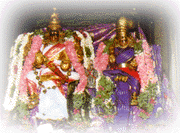 The temple is dedicated to Meenakshi, the consort of Lord Shiva. The
original temple was built by Kulasekara Pandya, but the entire
credit for making the temple as splendid as it is today goes to
Tirumalai Nayak who brought back glory to this magnificent
structure.
The temple is dedicated to Meenakshi, the consort of Lord Shiva. The
original temple was built by Kulasekara Pandya, but the entire
credit for making the temple as splendid as it is today goes to
Tirumalai Nayak who brought back glory to this magnificent
structure.
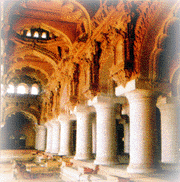 There is no other building in Madurai, which better illustrates the
architectural style of the Nayaks. The palace of Tirumalai Nayak is
about 1 km away from the temple. This Indo-Saracenic building was
constructed in 1523 and was originally four times as large as it is
today. This palace consisted mainly of two parts, namely
Swargavilasa and Rangavilasa which house the royal residence,
theatre, shrine, apartments, armoury, palanquin place, royal
bandstand, quarters, pond and gardens. The most remarkable part of
this palace is the dome of Swarga Vilasam, which lies beyond a huge
courtyard and is a magnificent example of the engineering skill of
its builders, rising as it does to a height of 20m without support
of any kind.
There is no other building in Madurai, which better illustrates the
architectural style of the Nayaks. The palace of Tirumalai Nayak is
about 1 km away from the temple. This Indo-Saracenic building was
constructed in 1523 and was originally four times as large as it is
today. This palace consisted mainly of two parts, namely
Swargavilasa and Rangavilasa which house the royal residence,
theatre, shrine, apartments, armoury, palanquin place, royal
bandstand, quarters, pond and gardens. The most remarkable part of
this palace is the dome of Swarga Vilasam, which lies beyond a huge
courtyard and is a magnificent example of the engineering skill of
its builders, rising as it does to a height of 20m without support
of any kind.