| Heritage
|
|||||
|
About Kolkata • Overview • History • People & Culture • Festivals • What to see • General Information More on W.Bengal • Overview • Darjeeling • Shantiniketan • Kalimpong • More Destinations • Wildlife Travelogues • Calcutta • Ruins of Pandua Leisure • Wildlife • Heritage • Pilgrimage | ||||
The Thakurbari was the hub of Bengal's cultural life for well over a
century. From the early nineteenth century, the Jorasanko Thakurbari was
flourishing and resonant, a pioneer in social reforms. The men of this
household were progressive and innovative thinkers. The women were also far
ahead of their times. They travelled to England and America for
intellectual pursuits, took part in the freedom movement and worked towards
promoting the cause of women. Digambari Devi, wife of Dwarknath Tagore, is believed to have consulted Brahmin Pundits on whether a wife could reject a husband who
had abandoned traditional principles. Maharishi Debendranath sent his
daughter, Saudimini, to Bethune College as one of its first students, setting an
example for other Bengali families. The very first progressive Brahmo Samaj wedding was also held in this household.
 The Thakurbari now houses the Rabindra Bharati Museum, which was inaugurated on May 8, 1961 by Pandit Jawaharlal Nehru. The museum has three impressive galleries. The first gallery covers the life and activities of Rabindranath Tagore. The second gallery portrays the distinguished members of his family like Dwarkanath, Maharishi Debendranath, Abanindranath and the brothers and sisters of Rabindranth. The third gallery tells the story of the Renaissance of nineteenth century Bengal and the part played by distinguished pioneers in different fields. Light and sound programmes are held in the evenings at Thakurbari, bringing alive the historic moments that encompass this house. Tapes containing Rabindranath Tagore's recitations are also played for visitors. It's an unforgettable experience to visit the room where Rabindranath Tagore was born, the garden which inspired his first poem, The Rain Patters, the Leaf Quivers, the verandah where he would sing to his father as a child, the kitchen used by his wife Mrinalini Devi, the family dining room, the terrace from where the young poet is known to have gazed dreamily at the vast expanse of the sky, the room where he spent the last day of his life. Interesting newspaper articles on Tagore and photographs of the poet with eminent personalities of his times are on display. The Assembly Hall of Jorasanko Thakurbari was the venue for religious gatherings of the Tagore household. On the stage, there's an engraved message reminding everyone that there is indeed one God who prevails. |
|||||
 |
|||||
Editor: Romola Butalia (c) India Travelogue. All rights reserved. |
|||||
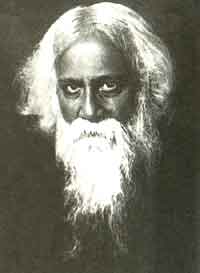 Bengalis are known to fondly call Kolkata the "city of Tagore, Teresa
and Ray". Jorasanko
Thakurbari - the ancestral home of poet, philosopher and Nobel laureate
Rabindranath Tagore, is a great place for the tourist who wants to feel the cultural history of Kolkata. Situated in Dwarknath Tagore Lane, the brick-red
structure of Thakurbari sprawls over a vast area. Open 7 days a week, entry
tickets are priced at Rs 10/-. Built in 1784, the house is named after
Debendranath Tagore, father of Rabindranath Tagore. Rabindranath was
born and brought up in Jorasanko Thakurbari, spent half of his life here and
also breathed his last here.
Bengalis are known to fondly call Kolkata the "city of Tagore, Teresa
and Ray". Jorasanko
Thakurbari - the ancestral home of poet, philosopher and Nobel laureate
Rabindranath Tagore, is a great place for the tourist who wants to feel the cultural history of Kolkata. Situated in Dwarknath Tagore Lane, the brick-red
structure of Thakurbari sprawls over a vast area. Open 7 days a week, entry
tickets are priced at Rs 10/-. Built in 1784, the house is named after
Debendranath Tagore, father of Rabindranath Tagore. Rabindranath was
born and brought up in Jorasanko Thakurbari, spent half of his life here and
also breathed his last here.