|
Travelogues Holiday in Bhutan
|
|||||||||||||||||||||
The kingdom of Bhutan lies to the North-East of India and is nestled between Tibet on the North, West Bengal on the South, Arunachal Pradesh on the East and Sikkim on the West. For five years, we were trying to get details about Bhutan, writing to various travel agents and visiting travel exhibitions. Finally we found a trip, within our budget, for my daughter and myself. On 17th October, we started on our journey by the Dadar Guwahati Express at 0755 hrs for New Jalpaiguri (NJP) in West Bengal. This train does not pass through Calcutta but goes via Barauni-Patna to NJP passing five states on the way. When we arrived on 19th Oct. at 0530 hrs, we were just a few hours behind schedule. We waited in the Ladies' waiting room at NJP for our tour assistant to receive us. It was raining when we took the cycle rickshaw to Siliguri, to the TSA Guest House that had a neat and clean room with attached bath and hot/cold running water. |
More on Bhutan • An FAQ
Travelogues
Trekking | ||||||||||||||||||||

By 11 am the next morning, we had started for Thimpu, 171 kms away, in a Toyota Coaster. Thimpu's summer temperature ranges from 8 to 20 degrees C. Being sparsely populated it has no traffic jams. We arrived 6 hours later crossing rivers, bridges, chortens and colourful religious flags printed with prayers, at every turn of the road. Chubby, cute little children going to school waved at us. We passed several Bhutanese men in their `kho' and women in their `kira'. Reportedly Bhutan is free of robbers, pickpockets, tipsy men and roadside romeos. We reached Hotel `Tandin' about a km away from the bus stop by paying Rs. 20/-. to the taxi. The walls of the Hotel were cheerfully painted with various signs and symbols related to Buddhism and Bhutan, including the auspicious and friendly Bhutanese dragons. At the time of our visit, there was no television in Bhutan, and we did not miss the TV at all.
The locals are fond of Indian film music which can be heard in buses and taxis. The languages spoken are Dzonkha and Hindi and some speak good English. Education and medication are free and hospitals are well maintained. However, it is advisable to carry your personal medication. There are now 35 post offices, but earlier there were runners to deliver messages We found that transportation by taxi was expensive. Rs. 400/- for sightseeing in Thimpu, Rs. 1200/- from Thimpu to Punakha (return), Rs. 500/- from Thimpu to Paro and Rs.1200/- for sightseeing in Paro inclusive of Chellila Pass. There were no local sightseeing buses at Thimpu but nevertheless we visited the Stupa and the Changanga Gompa containing the statue of Lord Buddha. The transmission tower point offers a panoramic view of the valley. When we visited the Queen Mother's palace we found that entry within is restricted. On the 23rd, we started for Punakha sharing the fare with 2 other passengers. Punakha is the ancient capital of Bhutan and located at a height of 5,000 ft. On the way we had to cross the 10,000 ft high Dochulla Pass through a thick fog which prevented views of the scenery. After crossing the pass, we came down to Punakha. On the way we passed the Pho Chu and the Mo Chu (Chu means river). They later meet at Sankosh Chu in Punakha. Near Sankosh Chu is the Dzonchung Monastary. This monastery is a 4 storied building with the top prayer room housing the statue of Lord Buddha.
Our diet consisted of fried rice, `ema datshi'--a Bhutanese dish made of cheese and chillies, `kewa datshi--a boiled potato and cheese dish and fresh fruit cocktail of peaches and apples with cream. The next day we went for local sightseeing in Paro by taxi for Rs. 550/-. We also took another taxi to Chillela Pass for Rs. 650 . In Paro we visited the Drukgyel Dzong (Druk=Dragon=Bhutan, Gyel=Victory). It is a fort cum monastery to commemorate the victory of the Bhutanese over the Tibetans. Finding it in a dilapidated condition we did not enter. From the Dzong we could see Mount Chomolhari's peak, the highest in Bhutan (24,000 ft.) and a gateway to Tibet. Chillela Pass is located 33 Kms. away at a height of 11,964 ft. As the fog cleared, we saw the distant snow covered peak of Mount Chomolhari. The Chillela pass divides Paro village and Haa village, from where one can go to Tibet on foot. There is a bus till Haa but a separate permit is required. The Paro museum is open on all days except Mondays and closes by 1600 hrs. It contains several photos of the Bhutanese kings and their dynasties, a huge collection of Bhutanese stamps, majestic `thankas', hats, swords, dresses, silver and copper vessels The most gorgeous of the exhibits was the 4 sided carved alter with statues of Lord Buddha with rows of lighted oil lamps and incense. The ambience of the room filled our hearts with joy and piety. We also visited Kichhu Monastery, the oldest in Bhutan (7th Century), built by Sumchhin Gelpo who was then King of Tibet. Next morning we left Paro with a heavy heart. We lunched at Hotel Sinchulla in Phuentsholing and stayed the night at Jaldapara Forest Resort, Cooch Bihar, West Bengal. After seeing Jaldapara Forest Museum, we proceeded to the same TSA Guest House at Siliguri, where we had stayed earlier. We visited a tea factory at New Champta, Gulmar District before boarding the Guwahati-Dadar Express. Because of chain snatching incidents we were advised to keep our windows shut during the night. It was a stark contrast to the paradise that we had visited. We offered a silent prayer that the Kingdom of Bhutan remain unspoiled forever.
|
|||||||||||||||||||||
 |
|||||||||||||||||||||
Editor: Romola Butalia (c) India Travelogue. All rights reserved. |
|||||||||||||||||||||
 After crossing a huge wooden arch, which separates the border, we entered Bhutan and felt as if we entered a magical fantasyland. Unlike West Bengal, tea is not grown in Bhutan, but apple, orange and peach trees can be seen. The staff at Hotel Sinchulla were dressed in their national costume and like all the Bhutanese people we met, were very polite. The hotel helped in arranging permits for visiting Thimpu, Paro and Wangdiphodrong. Uttam, who had accompanied us here, bade us goodbye.
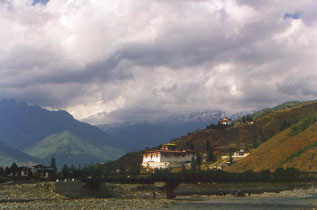 Next day, we left for Paro by taxi and checked in at Tiger Nest Resort. Paro is 65 kms. away from Thimpu at a height of 7,200 ft. Due to the mountainous winding roads, the journey took 2 hrs. Paro is colder than Thimpu and is a beautiful place with the hotel consisting of small cottages located at Satsum Chortem, overlooking the famous Tiger Top Monastery. The beautiful flowers and birds, the winding Paro river, the green rice fields and the entire area surrounded by fog-covered mountains makes it a paradise on earth.