|
Travelogues Made in India
|
|||||||||||||||
"What if it rains?" everybody questioned. Having been told that the legendary snake-boat race would go on despite rains, being held in the monsoon anyway, my greedy imagination desperately wanted it to rain - for it conjured the drama of boats against grey skies, rain-drenched bodies rowing against dark waters. It was a clear, dry day when we arrived in Allepuzha (aka Alleypey)! All roads lead to the boat race; especially if you get directions in Malayalam. The placards and hoardings at every nook and corner announced "Annual Nehru Cup Boat Race". None of them had directions. "This is like a treasure hunt", grumbled someone, as we walked, seemingly from one banner to another.
More About Kerala | • An Overview • Cochin
Travelogues
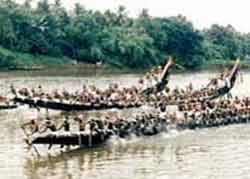
As the boat approached a wide curve of water - a flash of colour, the blur of hands. Twelve women, their saris neatly folded at the shoulder and tucked at the waist, whizzed past us in a boat. A man standing in the centre of the boat was clapping to a rhythm and chanting. I laughed at the luxury of a personal cheerleader, and later discovered he was the navigator. "Those women are completing the initial laps. The time clocked in the laps get them points", we were told. Somehow, I hadn't thought that the traditional races would have the paraphernalia of modern sport. This was the finishing point gallery. Wooden scaffolding in the water, with rows of chairs and matting to sit on. The front row spectators were sitting with their feet in the water. We wedged ourselves into the second row on the true blue Kerala coir mat (the design of which is imprinted as indelibly on my butt as on my memory, Harish later said). We learnt to identify the different boats and the referees, dressed in white sailor uniforms, rushing around in a boat, whistling furiously. The navigator set the beat, and thereby the pace. As the race progressed, the boats got longer. One boat race was manned by women. It was only when I saw the longer boats that I saw the navigator's role in action. There was one boat that was figuring out where to turn. The front- rowers rowed one way, and the back rowed the opposite way. The boat veered crazily, like a drunken man, making no progress, but moving all the time. The navigator shouted, gesticulated madly, set up a steady rhythm, and steered them the right way. The navigators of the longer boats used a long drum to beat on the floor of the boat for the rhythm. 
The snake-boat race is the grand finale. These elegantly carved snake-boats, with the front of the boat shaped like the raised hood of a snake, can seat 120 rowers. "Chundans", as they are called locally, take months to make, and cost thousands of rupees. Unfortunately, there is not much you can do with it after the race. Years back, it made sense, because the waterways were the only means of transport. This was an important port of trade, and boats were used for travel, transportation and even defence. Today cheaper, faster means of transport have made the boats too expensive for use. Many of the teams are sponsored, and you can see uniforms - bright T-shirts with logos and names. One of the teams was from a local beedi factory. I found myself enthusiastically standing up and cheering, with no idea what I shouted because I didn't know the team names, and certainly could not pronounce them. Some of the local folks jumped into the water in celebration when their team won!
It was almost six, so we headed towards the beach. Some of the guys decided to fly kites - like the young local boys. The smart aleck urchins started talking to us. One of us, the particular target of their curiosity- fair dressed in denim shorts, and unable to rustle up even a single word of Malayalam. "You made in India, sir?" asked one of the boys doubtfully. A fitting phrase indeed to describe the chaos, the elegant carved boats, the squalor, the grace, the energy, the yuppie frills to age-old traditions - a completely Made in India experience.
 Editor: Romola Butalia (c) India Travelogue. All rights reserved. | ||||||||||||||
 We reached a clearing with wooden scaffoldings, packed with people.
"This is the starting point. Your tickets are for the finishing point",
said the ticket-checkers. We had decided on the 'finishing point tickets'
after much debate regarding the best view of the race. So we trudged back to take a ferry that dropped us a couple of kms away to wait for the boat that would take us to the finishing point. When the boat arrived, everybody who was not in the queue boarded it. In the stampede, whoever pushed, or knew the policemen got in. Next door to this pandemonium, the sedate VIP queue advanced in sweet order. We abandoned our 'junta'
tickets, and paid for a VIP ride.
We reached a clearing with wooden scaffoldings, packed with people.
"This is the starting point. Your tickets are for the finishing point",
said the ticket-checkers. We had decided on the 'finishing point tickets'
after much debate regarding the best view of the race. So we trudged back to take a ferry that dropped us a couple of kms away to wait for the boat that would take us to the finishing point. When the boat arrived, everybody who was not in the queue boarded it. In the stampede, whoever pushed, or knew the policemen got in. Next door to this pandemonium, the sedate VIP queue advanced in sweet order. We abandoned our 'junta'
tickets, and paid for a VIP ride.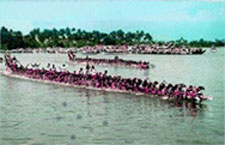 The final races took only a few minutes each, but were an
astounding spectacle. Each race was somehow different. One of the longer
boats lost control just after crossing the finishing line and
toppled into the water. And so the winning boat was upside down. Loud
laughter followed the sheepish rowers as they dragged the boat away.
The final races took only a few minutes each, but were an
astounding spectacle. Each race was somehow different. One of the longer
boats lost control just after crossing the finishing line and
toppled into the water. And so the winning boat was upside down. Loud
laughter followed the sheepish rowers as they dragged the boat away.
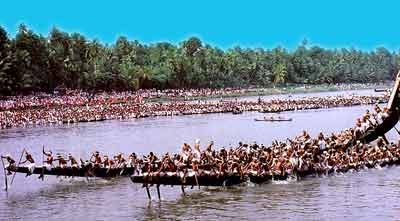 Perfectly synchronized, each lift of the arm, each swish of the oar to
the rhythmic beat of the navigator is a ballet - or a symphony. It is
also an incredible frenzied burst of energy - like those final moments
of a horse race. Difficult to describe, but impossible not to feel.
The organizers did whatever they could to mar the show - speeches,
advertisements, and cheer girls in skirts who went by
in a boat looking miserably out of place. It was quixotic to see a
prize-giving ceremony in the middle of water, in a boat.
Speeches over, we went out into the maddening heat, crowds, and stalls.
Perfectly synchronized, each lift of the arm, each swish of the oar to
the rhythmic beat of the navigator is a ballet - or a symphony. It is
also an incredible frenzied burst of energy - like those final moments
of a horse race. Difficult to describe, but impossible not to feel.
The organizers did whatever they could to mar the show - speeches,
advertisements, and cheer girls in skirts who went by
in a boat looking miserably out of place. It was quixotic to see a
prize-giving ceremony in the middle of water, in a boat.
Speeches over, we went out into the maddening heat, crowds, and stalls.