| Pilgrim Places Amarnath Yatra | |||||
Overview Pilgrimage is an important part of the Indian tradition. This soul-stirring journey is undertaken to have a face-to-face communion with the gods and experience a higher state of spirituality. Of all the pilgrimages, the one to Amarnath is considered as one of the most sacred. It is an event that tends to awaken the divinity embedded in the deep recesses of man's mind and to feel the serene impact of the Great Spirit. |
* Best Deals
Jammu-Kashmir | ||||
The cave is accessible only during a brief period during the months of July and August. The yatris encounter a charming environment of thick green forests, crystal clear waters of mountain streams and an exhilarating air. The spell that nature casts on the yatri's mind brings peace and creates within him a new rhythm, a new spirit. The enchanting route is traversed on foot or horse. The yatris feel a tremendous sense of fulfilment and all fatigue is forgotten. Even when the temperature touches zero degrees Celsius, the yatris are driven by their faith to take a dip in the almost freezing rivulet of Amravati. At the time of the yatra, inside the cave, a pure white ice-lingam comes into being. Water trickles, somewhat mysteriously, in slow rhythm, from the top of the cave and freezes into ice. It first forms a solid base and then on it a lingam begins to rise, almost imperceptibly, and acquires full form on Purnima. It is believed that on that day, Lord Shiva revealed the secrets of life to his consort Parvati, the beautiful daughter of the Himalayas. It is a mystery how the ice-lingam is formed on the ice-base, how it attains its full form and height on the night of the full moon, and how a pair of pigeons appears on the scene. Even the most sceptic mind is persuaded to believe that all these occurrences could not be a mere coincidence. In a state of heightened sublimity, the yatri experiences the impact of an invisible yet all-pervading, incomprehensible but all-conveying force. Lord Shiva, sitting calmly beneath an imperishable canopy, provided by the "mount of immortality" seems to convey in hushed silence the message of inseparability of the processes of creation and destruction.  Swami Vivekananda's experience at the holy cave was so spiritual and saturating that for days after he could speak of nothing else but Shiva all in all; the eternal one, the great monk, rapt in meditation and aloof from the world. Such is the impression that the Amarnath Yatra leaves on the minds of most of the yatris. But the significance of the yatra does not end at the personal level. It extends to the much larger issue of cultural unity and vision of India from Kashmir to Kanyakumari, from Kathiawar to Kamrup. Its great and historic importance as an underlying integrating force needs to be recognized. Legend On Parvati's insistence, Shiva agreed to reveal the secret of creation to her. Shiva found a secluded cave in the Himalayan range where he decided to impart the secret of creation. While he was revealing the absolute truth of immortality and eternal truth, Parvati dozed off. The cave in which Shiva had divulged the secret is now called Amarnath, meaning the Immortal God. It is believed that while Lord Shiva was speaking to Parvati, a pair of pigeons appeared and overheard the discourse. It is believed that every year, these doves come to Amarnath at the time of the yatra as an incarnation of Shiva and Parvati. Many pilgrims claim to spot these doves though there is no presence of any other birds in the area. During the period when the saint, Kashyap is believed to have drained the Kashmir valley, another saint travelling in the Himalayas discovered this cave and the lingams. When people heard about the discovery they came and called the cave Amarnath or the abode of Shiva. Later, a folk tale was attached to the legends, which claims that a Muslim shepherd, Buta Malik was given a sack of coal by a saint while he was in the mountains. When he returned home, Malik found that the coal had turned into gold. Malik rushed back to thank the saint but instead he found a cave and the lingams. This became a place of pilgrimage and till date, Muslim shepherds show the way to pilgrims. Part of the donations received in the cave is given to the descendants of Malik while the rest is directed towards the trust managing the shrine. Trek to Amarnath From Chandanwari, there begins a steep ascent to Pishu Ghati (3,171 meters), reminding the yatris that the path to salvation involves superhuman struggle and stamina. A feeling of having reached an ethereal destination overwhelms yatris when they reach Seshnag (3,570 meters) so striking is the beauty, the ambience and the very colour of this great lake. Seshnag symbolizes the cosmic ocean in which Lord Vishnu, the preserver of this universe, moves, reclining on a seven-headed mythical snake. The second night halt is at Wawjan overlooking the deep waters of Sheshnag Lake and the glaciers beyond it. The third and the last camp en route to the cave is at Panchtarni. This 13 km trek gains height at 4,600 m and then descends to the green meadows of Panchtarni. The cave is 6 km from here. There are long queues waiting to enter the cave for a darshan before returning to Panchtarni. The return journey takes two more days. There are few precautions which have to be taken on this yatra. Children below 12 years and infirms are not allowed. It is imperative that one is adequately equipped against the cold in the high altitude. It is important to be aware of high altitude sickness and take basic precautions to prevent it. There are ponies available to carry provisions and personal belongings. Managing this yatra is a mammoth task and requires planning and coordination. The committee managing the shrine keeps maintains the route, ensuring that it is free of boulders and snow, in co-operation with military and civil authorities. More recently, there have been incidents of terrorists having tried to disrupt the yatra, and there is heavy armed protection provided to the yatris. A yatra-officer is appointed to conduct the pilgrimage. General Information |
|||||
 |
|||||
Editor: Romola Butalia (c) India Travelogue. All rights reserved. |
|||||
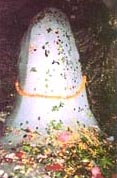 Range, the holy cave shrine of Amarnath is dedicated to Lord
Shiva, whose presence is associated with the dawn of time. The
oldest and most sacred book of Hindus, the Rig Veda mentions
the presence of the ascetic Shiva, the god of destruction.
Range, the holy cave shrine of Amarnath is dedicated to Lord
Shiva, whose presence is associated with the dawn of time. The
oldest and most sacred book of Hindus, the Rig Veda mentions
the presence of the ascetic Shiva, the god of destruction.
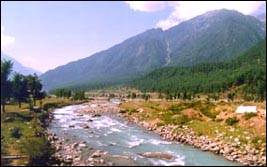 The yatra, in its present religious form, commences with the
ceremony of "Chari Mubarak," at the Dashnami temple, Akhara,
Srinagar. After the prayers, the yatri acquires a sort of
walking stick. It has both physical and religious
significance: physically, it helps the yatri in steadying
himself on a snow covered slippery path; spiritually it
reminds him of his resolve at the temple at times when his
faith begins to waver in the face of a long and arduous
journey. Nowadays people travel to Pahalgam first and then
undertake the onward journey of 45 km on foot, in batches.
Overnight halts are in encampments that are set up at fixed
distances and give the appearance of a military site. The
return trek has to be covered in five days with night halts at
Chandanwari, Wawjan and Panchtarni.
The distance of 12.8 km from Pahalgam to Chandanwari is
completed in five to six hours with the first night halt at
Chandanwari. The trail is along thick and green woodlands of
breathtaking beauty. The playful stream of Lidder meanders and
dances alongside, showing its sparkling white foam with the
pride and purity of a maiden descending directly from the lap
of the perennial Himalayas. One main attraction of this trail
is the bridge on the river Lidder, which is covered with snow
even when the surroundings are bereft of snow.
The yatra, in its present religious form, commences with the
ceremony of "Chari Mubarak," at the Dashnami temple, Akhara,
Srinagar. After the prayers, the yatri acquires a sort of
walking stick. It has both physical and religious
significance: physically, it helps the yatri in steadying
himself on a snow covered slippery path; spiritually it
reminds him of his resolve at the temple at times when his
faith begins to waver in the face of a long and arduous
journey. Nowadays people travel to Pahalgam first and then
undertake the onward journey of 45 km on foot, in batches.
Overnight halts are in encampments that are set up at fixed
distances and give the appearance of a military site. The
return trek has to be covered in five days with night halts at
Chandanwari, Wawjan and Panchtarni.
The distance of 12.8 km from Pahalgam to Chandanwari is
completed in five to six hours with the first night halt at
Chandanwari. The trail is along thick and green woodlands of
breathtaking beauty. The playful stream of Lidder meanders and
dances alongside, showing its sparkling white foam with the
pride and purity of a maiden descending directly from the lap
of the perennial Himalayas. One main attraction of this trail
is the bridge on the river Lidder, which is covered with snow
even when the surroundings are bereft of snow.