These are remarkable achievements for an economy that was tightly protected and controlled for 46 years from 1947 to 1993. What are most noticeable are the intangibles: the feel good factor, the "can do" attitude and the increasing amount of young managers that are turning entrepreneurs.
Foreign direct investment (FDI) has been liberalized such that inflows have increased from miserable $200m annually in the beginning of the '90's. India attracted $15.7 billion in FDI in the first 10 months of 2007, double the amount in the same period of 2006 ( yet far below the $74.7 billion China attracted in the whole of 2006). Foreign exchange reserves have climbed rapidly from USD 40 billion in March 2001 to 290 billion now. According to the Reserve Bank of India, the country’s foreign exchange reserves stood at $290.8 billion for the week ended February 8 2008, up 57% from a year earlier. This is striking when we recall that the level was near zero at the beginning of the reforms period, just a decade and a half ago.
| The Indian software
industry has achieved international recognition for its quality in software
development and has caught the imagination of the world.
|
| | |
|
As with any growing economy the sectoral composition of GDP has been changing with the services sectors showing an increased share and that of agriculture declining to nearly 20%. The fastest growing sector in the economy has been the Services Sector, which now accounts for over 50% of GDP.
|
Indian software exports boom
India's software and services exports have been rising rapidly. IT ,IT-enabled services, Business Process Outsourcing ( BPO) and other administrative support operations are together predicted to grow at 25% pa for the forseeable future.
Software exports now make up 20 % of India's total export revenue, up from 5 % in 1997. Currently, India exports services ( including software) worth more than $56 billion every year whereas its merchandise exports are over $100 billion per annum.IT amd ITES services alone are expected to export USD 40 billion worth in FY '08. Serrvices exports have been growing at an average rate of 28% per annum during the past 5 - 6 years while merchandise exports have maintained a growth rate of 22 % p.a. in this period.
According to a paper by the Federation of Indian Chambers of Commerce and Industry (FICCI), Indian services exports would be close to $311 billion by 2012 and are expected to overtake the expected level of merchandise exports of $305 billion. The study adds that India’s export of commercial services would cross that of China by 2009.
.
As per a Nasscom-McKinsey Study the IT and IT enabled services sector will account for 7 % of India's GDP by March 2008. The contribution of IT-ITES industry to country’s GDP grew from 4.7% of last year, thus providing employment to more than 1.6 million of our youth.
Due to large export earnings and other dollar inflows into the country from Foreign Direct Investment and Institutional money flowing into the stock markets, the Reserve bank of India is already facing a problem of plenty with dollar sterilisation leading to rupees being injected in the system, thus fueling liquidity that can lead to asset price bubbles. Some of this can already be seen in some real estate pockets and the stock marketwas till recently seen in the stock markets.
Principal industries are textiles, chemicals, food processing, steel, transportation equipment, cement, mining and petroleum. Main agricultural crops are - rice wheat, oilseeds, cotton, jute, tea, sugarcane, potatoes and livestock. India is the largest tea producer in the world.
The middle class constitutes some 250 million people and their purchasing power is growing. This is also the fastest growing segment among the economic classes. Rural consumption patterns too are changing with growing exposure.
The process of liberalisation had its growth pangs. While it led to faster growth, it also resulted in a painful restructuring process for Indian industry, which continues to this day. Industry responded to the challenge of domestic and global competition by going through a phase of restructuring, consolidation, mergers and acquisitions. Due to archaic labour and land laws some industries have not been able to weather the storm. However, the rest have emerged leaner, meaner and globally competitive.
Savings
The economy traditionally enjoys a high savings rate primarily because of the contribution of the household sector. Gross Domestic Savings are a high 32 per cent of GDP. This can go up if public sector savings are pushed up. The process of privatisation and reforms that has been launched for the public sector should facilitate the savings rate. Household financial saving approximates 10% of GDP.
Population
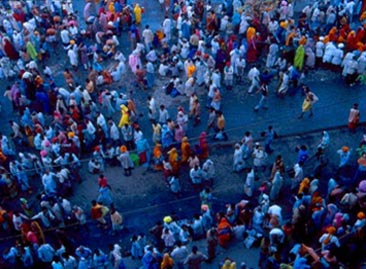
In the 90's the population growth rate came down from 2.1 % ( recorded in the previous decade) to 1.9 %. Population control will have to be achieved through education and improving standards of living.This is the second most populous country in the world, with a higher growth rate than China. India's population has crossed the alarming billion mark. 70 % of the population still lives in rural areas that are yet to witness the benefits of the reform process.
Poverty
Though the number of people living below the poverty line is sizeable, official figures estimate that the poverty ratio has reduced considerably. Though poverty is declining, it remains widespread. A recent estimates shows 250 million people below the poverty line (about one - fourth of the population) compared to about 164 million people in 1954, or about one-half the population at that time. About 10% of the population has risen above the poverty line in the past decade.
Inflation
With increased stability and diversification of the economy, post- reforms, the rate of inflation has drastically come down to around 4%.
Areas of Concern
Long neglected, the infrastructure sector needs to be the focus of attention. Teledensity has improved tremendously in the past decade. A revolution is taking place in the Cell Phone and Internet segments. It was just 10 years ago that cellphones were launched in the country. At that time teledensity was 66 per 1000. This has more than doubled to 15% in 2007 and expected to reach 18% in 2009. The mobile telephone has now become the highest selling consumer good in India, it has displaced the bicycle from the top slot. The Government has entrusted the national highways authority the job of developing expressways and four-lane highways. A grand expressway from Mumbai to Pune is the first of these to go on stream. The Govt. is working on a National Highway project of Rs.170,000 crore.The deadline for widening of 50,000 km of road and constructing 1000 kms of expressways is 5 years. All major cities, state capitals, ports and strategically important centres are expected to be connected through this network. The economic stimulus expected from the backward and forward linkages is expected to be huge.
| With increased stability
and diversification of the economy, post- reforms, the rate of inflation has
drastically come down to 4% in the current year. |
| | |
|
|

While, the process of reforms in the Telecom sector has been dramatic, and roads are catching up, power and ports continue to languish. Power shortages continue and will not be resolved till populist measures like free electricity offered to many sections are done away with. The National Sample Survey data on consumption expenditures points to a further widening of disparities between Urban India and Rural India. Nothing captures this reality more than the fact that the monthly per capita consumer expenditure in the first segment is 87 per cent higher than in the second. It has been pointed out by some that the nineties growth trajectory has benefited Urban India, particularly the top 30% of the economic segment, but has aggravated the rural-urban divide in consumer expenditures.
The primary area of concern is the fiscal deficit, which has been unchecked for too long. The Government's financial situation has been under strain and very little effort has been made towards long term structural reform. The task is now to increase revenues, reduce deficits in the public sector and reduce expenditure through appropriate policy actions. It remains to be seen whether political will can be mustered. The total budget deficit of centre and states combined exceeds 10 % of the GDP and total debt could be near 70% of GDP, or 400% of revenues.
Sleeping Elephant or Waking Elephant?
A sleeping elephant has woken up. But a billion people wait to see if the benefits of liberalisation, modernisation and a free market will percolate down to the 70% of the population untouched by reforms. The fact of India's anticipated emergence as a Global Economic Superpower is now widely acknowledged. The emergence of China and India as major global players, riding on a crest of economic success over the next 15 years, will transform the geopolitical landscape, says a US National Intelligence Council Report. It compares the trend to Germany’s rise in the 19th century and the US’s in the early 20th century. The NIC says that India, currently trailing China on most economic measures, could possibly overtake China as the fastest growing economy. Citing experts, it says India has several factors working for it.
India possesses world class capital markets and some of the best firms in some important high-tech sectors, which China has yet to achieve. India’s well-entrenched democratic institutions make it relatively less vulnerable to political instability.

Current Scenario
The years 2004 to 2008 have witnessed an upsurge in optimism. Expectations have risen and consumer confidence soared on the assumption that that the Economy would now capitalise on its intrinsic strengths. There is renewed optimism that it can reach its recognised potential of a sustainable 8 % p.a. + GDP growth if the second phase of reforms is carried out in a time bound manner over the next few years.
Amidst this upbeat mood, the flip side has to be kept in mind. In several Indian Economic surveys tabled in Parliament, the Finance Ministry had stated that fiscal consolidation has to be given a priority so that funding to the private sector is not crowded out. The Economic Surveys have called for a cut in untargeted subsidies and encouraging public investment in physical and social infrastructure. It has also recommended streamlining the tax system to shore up revenues. The areas earmarked for rationalisation of subsidies are food, fertilisers, liquefied petroleum gas (LPG) and kerosene. All these are areas where it will be politically difficult to implement cuts and is a huge area of concern to economists. However, slow reforms with no upheaval are preferable to social disruptions.
Meanwhile both Industry and Services sectors seem to be growing at 10 % per annum. There is now more evidence to suggest that the Indian economy may be entering a phase of sustained investment-led growth. Major capacity expansions are being planned in the manufacturing sector. The last time such big investments took place in the industry was during 1993-96. There are clear signs that most industry segments are operating at full capacity. Further capacity building exercise has begun in sectors such as steel, cement, aluminium, paper, textiles and automobiles.
Investments had been subdued for many years. The last 2 years have seen a reversal of this trend.
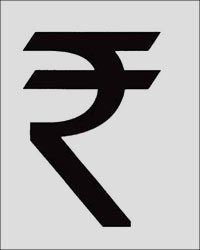
During the past few years, the rupee has been strengthening against the US $. In July 2002, the rupee traded at 48.67 to the dollar. In November 2006, it was trading at 44.60. In February 2008 it is trading at 40.00.
The external debt situation has improved significantly in recent years and the external debt-GDP ratio decreased from 28.7% at the end of March 1991 to 21 % currently.
Capital markets
Capital markets had been subdued for a long time. The NSE-50 index, which was at around at 1,000 in January 2003 has since surged. Even after a 15% recent correction the index is at 5000 levels in February 2008. A new found confidence in the Indian Economy and its growth prospects have seen inflows to the Indian Capital markets. And India now aims at emerging as an economic superpower in the coming decades. But this is expected to be a steady elephants pace and not a Chinese tigers pace. India will grow and become a superpower in the next two decades but for various sectors and sections of the economy, the journey will be in fits and starts. The creaky bureaucracy and vested interests entrenched over the last five decades now seem to be India's biggest stumbling block and will be the last to reform.