|
India Facts Tradition Style and Splendour
|
||||||||||||||||
India is a land of colour and diverse cultures, so obvious in the varied dresses that adorn its people. Indian dressing styles are marked by many variations, both religious and regional with a wide choice of textures and styles. The many hued sari draped gracefully in different styles, brightly mirrored cholis, colorful lehangas and the traditional salwar-kameez have all fascinated the traveller to India. |
Passage to India • Overview • History • Dateline of Events • Time Periods • Geography • Economy • Polity • Religion • Festivals • Languages • Travel Tips • Special Features | |||||||||||||||

A popular, comfortable and convenient dress is the salwar kameez or churidar kurta. This was traditonally the dress worn in Punjab, but is now worn almost everywhere, particularly among the younger generations. The kameez or the kurta is a knee-length flowing tunic worn over a salwar or churidar. A salwar is a pyjama-like trouser which tapers slightly towards the ankles, while the churidar is a tight-fitting trouser which gathers at the ankles. These gathers at the ankles look like bangles (churis) and hence the name. A dupatta generally completes the ensemble.
In India, as elsewhere, accessories are an integral part of the ritual of dressing. The world over, Indian women are associated with the 'dot' in the middle of their forehead, called Kum Kum or bindi. Traditionally round, the bindi is now available in various colours, shapes and sizes. A bindi was traditionally a sign of marriage, or in some states, was worn as soon a s a girl reached young adulthood. Today it is for the most part an adornment. Vermilion or sindoor applied at the parting of the hair indicates a married woman. A traditional Indian woman is rarely seen without jewellery. A mangal-sutra, a necklace made with black and gold beads is considered sacred, and in many areas is always worn by a married woman. Many women, particularly in the rural areas of Rajasthan, Maharashtra and Gujarat wear ornately crafted nose-rings. Gold, silver or colourful glass bangles are another favourite, dating from the tradition of never having your hands bare. Women in Rajasthan wear bangles that go all the way to their shoulders. Indian women generally have their ears pierced, and commonly sport ear-rings. Men are considerably less traditional when it comes to dressing. In urban areas, they have adapted to a western style of dressing. In villages men generally wear kurtas, a knee length shirt-styled tunic, with lungis, dhotis or pyjamas. The lungi originated in the south but is now worn all over india. It is a piece of cloth wrapped around the waist. A dhoti is longer than a lungi, has sari style pleats and is draped through the legs. In states like Rajasthan, Gujarat, Punjab and Maharashtra men wear a safa or turban on their heads. Elsewhere too, various kinds of topis are It is a long scarf which is wound round the head in different ways. The Pathani suit is very similar to the salwar-kameez and is generally worn by men in north India. The Achkan is a long collarless jacket worn over a churidar for formal occasions.
Compiled by Romola Butalia
|
||||||||||||||||
 |
||||||||||||||||
Editor: Romola Butalia (c) India Travelogue. All rights reserved. |
||||||||||||||||
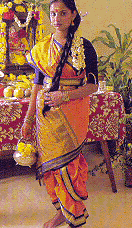 The sari, simple, understated yet supremely elegant is increasingly
becoming a fashion statement in urban India. One of the most
commonly worn traditional dresses, it is essentially a rectangular
cloth measuring about 6 yards, though in Maharashtra, women wear the
nine yard sari which is passed through the legs and tucked in at the
back. The sari comes in a profusion of colours, textures and
designs, determined largely by the region. There are several ways of
draping a sari, which is first wound around the waist, before being
pleated seven or eight times at the centre and tucked into the
waistband. These pleats are called the patli. The remaining sari,
called the pallu is then pleated again and draped across the left
shoulder to fall gracefully behind. There are regional variations,
like in Gujarat, the pallu comes from the back, and drapes across
the front over the right shoulder. The sari is worn with a
tight-fitting choli or blouse. The style and length of the choli
varies according to fashion trends and from region to region.
The sari, simple, understated yet supremely elegant is increasingly
becoming a fashion statement in urban India. One of the most
commonly worn traditional dresses, it is essentially a rectangular
cloth measuring about 6 yards, though in Maharashtra, women wear the
nine yard sari which is passed through the legs and tucked in at the
back. The sari comes in a profusion of colours, textures and
designs, determined largely by the region. There are several ways of
draping a sari, which is first wound around the waist, before being
pleated seven or eight times at the centre and tucked into the
waistband. These pleats are called the patli. The remaining sari,
called the pallu is then pleated again and draped across the left
shoulder to fall gracefully behind. There are regional variations,
like in Gujarat, the pallu comes from the back, and drapes across
the front over the right shoulder. The sari is worn with a
tight-fitting choli or blouse. The style and length of the choli
varies according to fashion trends and from region to region.
 Young girls in south India wear a half saree, somewhat similar to a
lehenga choli. The only difference is that the dupatta is wound
across the waist and draped across the left shoulder like the saree
pallu.
Young girls in south India wear a half saree, somewhat similar to a
lehenga choli. The only difference is that the dupatta is wound
across the waist and draped across the left shoulder like the saree
pallu.