|
Travelogues Bhutan: Land of the Peaceful Dragon (Part 3)
|
|||||||||||||||
After visiting Paro, we twisted along the bends on the serpentine roads towards Chelela Pass, 3988 m above sea level. Bhutan is rich in flora and fauna and the hillsides are dense with many kinds of conifers. It was one of the most beautiful drives as we climbed higher and the temperature dropped. Chelela is like a saddle over two ranges overlooking Paro
and Haa Valleys on either side.
It was a lofty feeling perched seemingly on top of the world with the sky seemingly closer and so many mountains below us. In the distance we were told was Chomolhari, the abode of the goddess of that name. This sacred mountain marks the border with Tibet's Chumbi Valley and is one of the few Bhutanese peaks to have been conquered by man. An Indo-Bhutanese team scaled its 23,997 feet in April 1970. How I longed to see the peak. As we stretched our legs, and took a breather from the winding, twisting roads, we drank in the crisp, cool pristine air, and felt so close to the azure skies, and surely, heaven itself.
|
More on Bhutan • Overview • Places to Visit • FAQ
Travelogues
Photo Gallery | ||||||||||||||
 As we descended from Chelela to the other side of the range, we had a panoramic view of Haa Valey. There were three separate distinct hillocks, jutting out like three senators, in the centre of the valley. Haa Valley has been the stronghold of the Dorji family and the Dzong and the main home were built by Kazi Ugyen Dorji and Raja S.T. Dorji. We were honoured to be escorted by T.S. Dorji (Tobgye), who is the grandson of Raja S.T. Dorji. He regaled us with snippets of the valley's history. He said his parents had nicknamed these three mountains after their three sons, Benji, Calden and Tobgye. Previously it had been the home of the Dorji family, however, the Dzong and the Dorji home had been loaned to house the IMTRAT (Indian Military Training Team) and recently was sold to the Bhutanese Army. The Army called it, HAA or high altitude area.
The bazaar area consists mainly of single storied residential cum commercial buildings. This type of house is found in virtually every village bazaar of the Inner Himalayan Valleys and is, as a rule, the accommodation of Ngalpos. These are descendants of Tibetans who, in the course of time, settled in Bhutan. This group is predominantly engaged in shop-keeping and other forms of trade and rarely practice agriculture or animal husbandry. The Haa Chu flows through here. There is an unique 9 hole golf course which criscrosses the 'chu'. It is one of the prettiest courses in the world. There is a hole on an island with the river forking its way around it and it is accessible only by a bridge. The constant gushing of the river and the gentle 'swooshing' breeze through the willow trees lining the golf course make concentration an effort. This pristine and stunning scenery was accessible to us only because the previous restriction on tourists had recently been lifted.
A chorten is a receptacle of worship, equivalent to an Indian stupa where relics of Buddhist divines were deposited - but gradually it acquired a halo of sanctity and was considered to be a means of attaining Nirvana. It's main architectural characteristics are that it has a square base, on which the main structure rises with diminishing breadth. It is closed on all sides and contains the sacred relics deposited there. Traditionally they beckon people to follow the path of righteousness. The Indian stupa was transformed in Tibet from where it came, to Bhutan with its complex structure and symbolism. Bhutanese religious books describe eight kinds of chortens:
Phuntsholing is perhaps the most easily accessible town from the Dooars and the airport at Siliguri. It is well worth a trip, specially, a pastoral getaway from dusty, grimy, overpopulated cities. Once away from the congestion there is an immediate relaxation of tension, where the nerves just slip into a resting mode. And in that state of calm and contentment, we returned home to Kolkata.
|
|||||||||||||||
 |
|||||||||||||||
Editor: Romola Butalia (c) India Travelogue. All rights reserved. |
|||||||||||||||
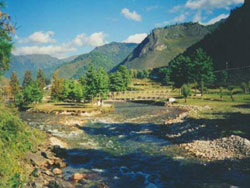 This valley lies to the extreme west of the country at an elvation of 9,000
feet and is almost flat. It was the ancient centre of trade with Yatung in the Chumbi Valley of Tibet. The shops are old fashioned and primitive, full of inexpensive Chinese goods as Haa is only a day and a
night's march from the border of Tibet. The architecture of the houses in this valley reflects the comparative wealth of this prosperous area.
Besides a fertile soil, its location at a short distance from Chumbi Valley in Tibet, connected by low passes, has been responsible for the wealth founded on trade between the two areas.
This valley lies to the extreme west of the country at an elvation of 9,000
feet and is almost flat. It was the ancient centre of trade with Yatung in the Chumbi Valley of Tibet. The shops are old fashioned and primitive, full of inexpensive Chinese goods as Haa is only a day and a
night's march from the border of Tibet. The architecture of the houses in this valley reflects the comparative wealth of this prosperous area.
Besides a fertile soil, its location at a short distance from Chumbi Valley in Tibet, connected by low passes, has been responsible for the wealth founded on trade between the two areas.
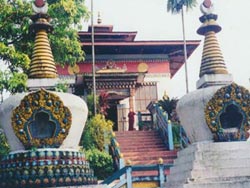 Next to the royal grandmother's palace is Rinchendeng Gompa. It is said
that many Lamas went to Benaras and other holy places in India
from where they brought back clumps of mud and that the main deity has been made with the mixture of this holy mud. It is one of the most beautiful monasteries to have been built in recent times, and perhaps the only one with a line of four 'chortens' at the entrance.
Next to the royal grandmother's palace is Rinchendeng Gompa. It is said
that many Lamas went to Benaras and other holy places in India
from where they brought back clumps of mud and that the main deity has been made with the mixture of this holy mud. It is one of the most beautiful monasteries to have been built in recent times, and perhaps the only one with a line of four 'chortens' at the entrance.