| Destinations
|
|||
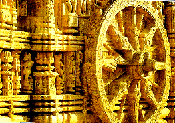
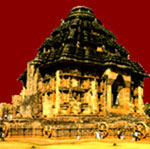
 Orissa has many claims as a tourist attraction. It contains exquisite temples, superb monuments, inviting beaches, enchanting wildlife and natural landscapes. Perpetually washed by the blue waters of the Bay of Bengal, it lies on the east coast of India with a coastal stretch of 482 km. The ancient arts of temple building and stone carving bloomed at Bhubaneshwar and Konark. The temple of Jagannath at Puri, is one of the holiest Hindu shrines and attracts thousands of people from all over the country. The province provides an excellent retreat for those seeking a change from the din and bustle of urban life. Most of its vast area is covered by lush green forests, paddy fields and picturesque villages. In the state, the visitor will also find the largest concentration of India's oldest inhabitants, the adivasis. Located in eastern India, Orissa covers an area of 1,55,707 sq km and houses a population of 31,659,736 (1991 census). It is bounded by West Bengal on the north east, Bihar on the north, Madhya Pradesh on the west, Andhra Pradesh on the south and the Bay of Bengal on the east. Bountiful in natural beauty: it has extensive sea-beaches; jungle clad blue hills of the Eastern Ghats; river valleys of the Mahanadi, Brahmani and Baitarani; and sprawling rice fields. |
More About Orissa • History • Geography • Culture
Places to Visit
Travelogues
Leisure |
||
 Visit the sea shores, marvellous temples, ancient caves of Udaygiri and Khandagiri, Similipal National Park and Tiger Project, Ushakoti Wild Life Sanctuary, Lake Chilika, Hirakud Dam and steel plants of Rourkela. Travel by road or rail and enjoy the lovely views and wild life in sylvan surroundings on either side.
Approximately 40% of the province is covered by forests with a variety of plant life - there are sal, piasal, sanghan, rosewood, gambari, bandhan, haldi, mango, and coconut and palm groves. There are tigers, leopards, wolves, bears, deer, sambar, black bucks, boar, elephant, quail, hare, black partridges, jungle fowl, wild ducks, crocodiles and alligators. Fish of various kinds breed here, including hilsa, prawns and oysters.  Orissa has a wide range of colleges providing courses in Medicine, Engineering, Arts, Sciences, Law, Ayurveda and Homeopathy. Cuttack is the cultural centre of the state with a range of cultural and literary societies. Administratively, Orissa is divided into 30 districts, of which Baleshwar, Bhadrak, Kendrapara, Jagatsinghpur, Puri and Ganjam are situated on the coast of the Bay of Bengal. The capital Bhubaneshwar is situated in the Khordha District. The Governor is the constitutional head of Orissa and the chief executive of the state is the Chief Minister. The Chief Minister appoints a council of ministers from the Legislative Assembly. Members of the Legislative Assembly are divided on the basis of the political parties they represent. More than 80% of Orissa's population lives in villages. The most thickly populated areas are the fertile coastal tracts and the least populated areas are the Eastern Ghats. About 24% of the population is tribal - their love for song and dance and their simple enjoyment of life and their customs and institutions are fascinating subjects of study.
The Oriyas have a feeling for beauty which has found expression in a rich heritage of arts and craft. Using local materials, Orissa's craftsmen combine utility with beauty. The tourist may see and purchase different handicrafts at the Cottage Industries Emporia at Bhubaneshwar. Stone carvers fashion miniature replicas of Orissa's great monuments, the folk tradition in art finds representation in wooden toys and the images of Lord Jagannath, the pat paintings depict episodes from Hindu mythology in bright and vivid colours. Cuttack specializes in delicate silver filigree and ivory work, and Orissa's saris and curtains with distinctive designs are the vogue among connoisseurs. The cuisine of Orissa has its speciality, don't forget to taste the native Oriya sweets and its pickles and sea food. Economy Festivals: The winter season, November to March is the best time of visit to the state. There are both Western and Indian style hotels and Orissa is well served by a nation wide transport service. A trip to Orissa will remain a lifetime experience. Compiled by Pallavi Bhattacharya |
|||
 |
|||
Editor: Romola Butalia (c) India Travelogue. All rights reserved. |
|||
 The language of the vast majority of the inhabitants of Orissa is Oriya, but in some places, Bengali and Telugu are also spoken. Tribals have their own dialects. The Oriyas believe in cosmopolitanism based on the cult of Lord Jagannath of Puri. All temples including that of Lord Jagannath are open to Harijans. Besides Hinduism other religions followed in Orissa include Buddhism, Jainism, Christianity and Islam.