| Destinations
|
|||
The Suru and Zanskar Valleys are adorned with a number of spectacular mountain peaks that attract climbers from the world over. In particular, the Nun-Kun massif serves as the focus of increasing mountaineering activities in the region. Its easy accessibility by road and the shortest possible approach march to reach the base camps makes the Nun-Kun massif one of the most attractive mountaineering destinations in the Western Himalayas. Nearby is the Zanskar massif with several challenging peaks surrounding the majestic Drang-Drung Glacier, adjoning Penzi-La. This massif too is accessible by road upto the base of the glacier and the approach trek to the base camp is at a day's trek from the road head.
The most frequented climbing area, the Nun-Kun massif comprises several peaks, chief among them being Nun (7135 m) and Kun (7087 m). Kun was the first to be conquered in 1913 by the Italian mountaineer Piacenza, while Nun, the highest summit of the massif, was first scaled by the Swiss climber, Madame Claude Kogan in 1953. The massif falls on the Kargil-Zanskar road. It is approached both from Tangol (70 kms from Kargil) and Guimatongo (110 km from Kargil), depending upon the route of ascent allotted by the Indian Mountaineering Foundation, the mountaineering controlling agency of the Govt. of India. |
More on Ladakh • Overview • Introduction • Zanskar • Drass • Kargil • Mountaineering • Ladakhis Places to Visit: • Drass • Gulmarg • Jammu • Pahalgam • Sonamarg • Srinagar • Ladakh • More on Ladakh •
Adventure |
||
Some approaches are also made from Parkachik (90 kms south of Kargil) along the Parkachik glacier. The approach from Guimatongo involves crossing the Suru River which has to be forded in the absence of a bridge; a foot-bridge is likely to be launched here soon. The base camp can be reached after a day's trek, both from Guimatongo and Tangol.
Other known peaks in the massif are Pinnacle (6930 m), White-Needle (6500 m), Z-1 (6400 m) and D-41 (5600 m). In addition there are many unnamed peaks in the altitude range of 5500 m to 6509 m in the same area. Adjacent to the Nun-Kun massif is the `Bobank Peak (5971 m) which is also frequented by foreign climbing expeditions. It is approached via the Chelong Valley westward of Pankhar.
The climbing period in the region extends from early June to mid October, the main climbing period being June-August when most of the Himalayas remain inaccessible due to the monsoon elsewhere, while the ladakh Himalayas remain un affected. Every foreign mountineering expedition has to obtain permission in writing from the Govt. of India through the Indian Mountaineering Foundation. A booking fee depending upon the height of the peak is charged and a Liaison Officer is provided with each climbing team. Information: Courtesy Govt of India |
|||
 |
|||
Editor: Romola Butalia (c) India Travelogue. All rights reserved. |
|||
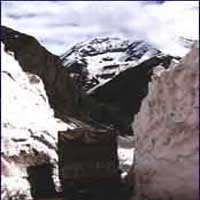 Nun-Kun Massif:
 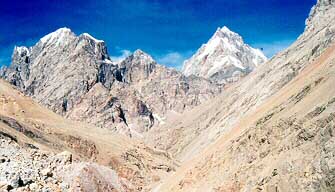 The Zanskar Group: